English version
THE UNFINISHED OBSERVER / OBSERVATOR INCOMPLET
Seven Poems, Two Languages, Two Sonic Universes, One Consciousness
Paul Seling · 2009–2026 · Pixel Punk Records
I. August 2009. The Moment of Writing
From what I have come to understand through reading the seven poems and working together on their reinterpretation, August 2009 represents a moment when writing no longer functions primarily as an expression of experience, but as an instrument for investigating experience itself.
These are not confessional poems in the conventional sense. The author does not attempt to recount events, recover relationships, or preserve memories. He seems more concerned with the mechanisms through which consciousness produces explanations about itself and the external world. Language becomes both the instrument of investigation and its object.
The seven texts possess something spontaneous, unfinished, occasionally deliberately awkward. Their English is not always conventional, and certain formulations seem to emerge before the underlying thought has fully taken shape. This is precisely what lends them authenticity: thought is not presented retrospectively in an orderly form, but captured as it unfolds.
In Brutal Chit Chat, communication itself is questioned. Two people may speak without communicating anything, while silence can become a more intense form of communication than speech. In Well-Known Orbits, freedom confronts the possibility that our movements may already be determined. The World of Undo imagines a world where mistakes can be erased, yet time and the consequences of existence remain fundamentally irreversible.
Perfect Mirror Reflections investigates identity through the presence of another. Corrupt Memory introduces memory as a mechanism of distortion and self-deception. Curious People transforms curiosity into a circular relationship between observer and observed. Finally, The Circus Crew reduces the spectacle of existence to a single participant who performs every role and continues to believe the applause is meant for him.
Considered together, the poems form a remarkably coherent system. Not necessarily because they were conceived as a rigorously structured cycle, but because they repeatedly return to the same problem: how can consciousness verify reality using its own instruments of perception, when those very instruments are themselves suspect?
There is also a tragicomic dimension. The author is not merely a solemn observer preoccupied with the great questions of existence. He is also a participant in his own absurdities. He contradicts himself, mocks himself, acknowledges his errors, and then continues repeating them. At times, he seems to be dismantling a mechanism from which he cannot escape.
The poems alone cannot tell us which personal events may have prompted their creation. Nor would it be appropriate to invent an explanatory biography. What we can identify is an intellectual disposition: distrust of certainty, sensitivity to the mechanisms of self-deception, and a persistent need to formulate questions even when answers appear impossible.
August 2009 is therefore more than the date when the literary material was produced. It is the point of origin of an experiment that would acquire a second existence seventeen years later.
II. 2026. Encountering the Author of the Past
Returning to the poems in 2026 introduced a new problem: the author reading them now is no longer identical to the person who wrote them.
This distance is not merely chronological. Over seventeen years, experience, vocabulary, artistic taste, one’s relationship with technology, memory, and the interpretation of one’s own past all change.
Rather than correcting the poems to make them conform to the present author’s sensibility, we chose to preserve their original character in the English version. Poetically acceptable awkwardness, discontinuities, and unexpected formulations became part of the work’s identity.
This was an important decision. An excessively elegant rewriting would have replaced the voice of the 2009 author with that of the 2026 author. We might have obtained more controlled literature, but we would have lost the very distance we were attempting to explore.
In this sense, the English version is closer to a recovered document subjected to sonic reinterpretation than to a rewritten literary work.
Yet the music does not attempt to reconstruct 2009. We did not seek the sounds of Bucharest at the time, the equipment characteristic of that period, or a recognizable musical nostalgia. We constructed an abstract space in which the poems could exist without being required to represent a particular place or historical moment.
Here lies the first major distinction between the two ages of the project: the texts belong to 2009, but their sonic universe belongs to the interpretation of 2026.
Contemporary technology, including AI-assisted generative tools, introduced another layer of mediation. We no longer have merely an author reinterpreting his own texts, but also a generative system proposing sonic structures, voices, errors, and associations that the author accepts, rejects, or transforms.
The process itself thus begins to resemble the subject of the poems: an observer attempts to understand himself through an instrument whose mechanisms he does not fully control.
III. Why We Chose to Translate the Poems into Romanian
Initially, translation might have seemed relatively straightforward: preserving the meanings and structures of the English poems in another language.
The first attempts revealed, however, that literal fidelity was insufficient. Certain expressions became too harsh, too explicit, or too close to an already formulated philosophical discourse. The Romanian reproduced the ideas, but not the uncertainty from which they seemed to originate.
This led us to a fundamental decision: the Romanian version should not be a translation of words, but a reconstruction of the thinking process.
We preserved the conceptual architecture of each poem while allowing Romanian to generate different images, pauses, and relationships between ideas.
We moved toward a sensibility related to contemporary Japanese minimalism: attention to intervals, empty space, minute gestures, and objects without declared significance. But we did not seek to imitate a Japanese poetic tradition. We adopted a principle of expressive economy and expanded it into a more complex, contradictory stream of consciousness, sometimes almost maximalist in its implications.
We also established an unusual condition: the Romanian world of 2009 should not appear through explicit cultural, historical, or geographical references.
We did not need apartment blocks, trams, advertisements, politics, the post-communist transition, or nostalgic objects. Bucharest would exist as an invisible context rather than a setting.
In this world, contrasts are not given in advance. There is no clearly defined exterior against which consciousness can orient itself. Differences between proximity and distance, light and darkness, past and present, self and other must be constructed through language.
The observer does not simply describe the world. Through formulation, he attempts to produce the very conditions under which the world can be perceived.
This gave rise to the central image of the Romanian version: a sentimental machine, deprived of reference points and memory, which nevertheless continues to experience affection, nostalgia, curiosity, sadness, and the need for recognition.
It never declares itself a machine. It does not explain what it lacks. It does not claim an identity.
It speaks.
And through speaking, it attempts to exist.
This choice also explains the Romanian title, Observator incomplet. The absence of the definite article makes it resemble a provisional classification, a technical record, or the description of an entity that has not yet been fully defined.
In the English version, the observer is unfinished because observation never reaches completion. In the Romanian version, he is incomplete because even the premises of his existence have not been fully established.
IV. The Two Sonic Universes
Both albums begin from the same premise: music should not illustrate poetry. It should constitute a second level of investigation.
Yet during the creative process, the two versions acquired distinct identities.
The English Version — The Unfinished Observer
For the English version, we constructed an abstract electroacoustic universe using minimal electronic synthesis, suspended frequencies, granular textures, magnetic tape noise, microscopic acoustic events, and reverberant spaces impossible to locate.
The voice is treated as sonic material, not merely as a carrier of meaning. It may be interrupted, fragmented, repeated, stretched in time, or absorbed into the texture.
The sonic space is grey, almost homogeneous, without stable coordinates. Sometimes a sound seems to originate in a tiny room; at other times, in a corridor of impossible dimensions.
This universe does not represent an external world. It resembles the interior of an information-processing system in which events are constantly reorganized.
We accepted errors, distortions, and discontinuities generated by technology whenever they contributed to the project’s central idea. They could become sonic equivalents of the perceptual and interpretive errors described in the poems.
The intended result was music in which language, memory, and perception disintegrate into their elementary components.
The Romanian Version — Observator incomplet
Here we began with the same abstraction but gradually discovered the need for a different sensibility.
The first electronic proposals were too close to IDM, glitch, and a recognizable vocabulary of Western experimental music. They were sonically interesting but possessed too much cultural identity. Their musical lineage could be identified.
We progressively eliminated these signals.
We sought electronics without a recognizable origin, combined with principles associated with contemporary Japanese composition: space, asymmetry, economy, microvariation, and the relationship between sound and silence.
We nevertheless preserved complexity. We did not want decorative, soothing minimalism reduced to a few beautiful notes and long reverberations. We wanted music that appeared simple while containing elaborate internal processes.
Every sound had to seem necessary, without explaining why it existed.
As we worked through the seven pieces, we allowed each to develop its own organizing principle.
1. Brutal Chit Chat — The Emergence of Language
Almost immaterial sounds, pure frequencies, delicate resonances, and expansive silences. The voice attempts to establish the first differences between things. Communication emerges before its meaning can be established with certainty.
2. Well-Known Orbits — The Emergence of Movement
Tiny mechanical contacts, friction, vibrations, and nearly inaudible mechanisms enter the sonic field. Repetition does not create a beat, but the sensation of predetermined movement whose cause remains unknown.
3. The World of Undo — The Distortion of Time
Here we introduced the idea of the recursive spiral. Sounds fold back into themselves, change scale, disappear, and reappear. Immense spaces contract to microscopic dimensions, fragment, and reassemble. Time is no longer a linear succession but a process that continually alters its own measure.
4. Perfect Mirror Reflections — Impossible Nostalgia
We initially experimented with a discreet acoustic guitar but abandoned it because it introduced an overly explicit musical familiarity. We retained hiss, foley, magnetic tape, and a few synthetic resonances. We did not want nostalgia for an era, but nostalgia for a possible existence that never occurred.
5. Corrupt Memory — The Descent into Darkness
For the first time, the voice is female. An intimately recorded grand piano, with short room reverberation, attempts to create and recreate unstable harmonies. The entire orchestration is subordinated to the deterioration of severely worn magnetic tape. Melancholy remains at the surface; beneath it lies a much deeper sorrow, without ornament or consolation.
6. Curious People — The Return of Play
An imaginary child’s room bathed in faded Technicolor sunlight. Microscopic toy mechanisms, a discreet Rhodes electric piano, hybrid digital-analog distortions, foley, and worn magnetic tape. We are not reconstructing childhood but inventing the possibility of a childhood. Light returns without resolving uncertainty.
7. The Circus Crew — The Failure of the Spectacle
We began with circus-like dissonance, barrel organ, accordion, and toy instruments, but discovered that literal representation became too theatrical. We sublimated these elements into austere electroacoustic avant-garde, leaving only traces of the tragic and the comic: exhaustion, hunger, precariousness, abandoned dignity, and an absurd need to continue performing.
This evolution was one of the most interesting discoveries of our collaboration. We did not define a complete style in advance and apply it mechanically to every poem. We allowed each text to subtly modify the rules of the shared universe.
The Romanian album is therefore not merely a sequence of seven tracks. It is a sequence of seven ways in which consciousness attempts to organize reality: through language, movement, time, relationships, memory, curiosity, and spectacle.
V. Voice, Technology, and the Working Method
We paid particular attention to the voice.
We did not seek theatrical interpretations, solemn recitations, or demonstrative expressiveness. On the contrary, we attempted to eliminate the gestures through which a performer tells the listener what to feel.
The mature male voice is intimate, restrained, occasionally hesitant. It seems to discover sentences as they are spoken. Emotion is not declared; it appears as a small deviation from neutrality.
In Corrupt Memory, the female voice introduces an essential difference. We do not know whether it belongs to another person or to another manifestation of the observer. That ambiguity is precisely what makes it interesting.
We also developed detailed instructions for diction, breathing, pauses, emotional fluctuation, and sonic direction, using English instructions for Suno while preserving the poems in Romanian.
These instructions were not intended to control every second, but to define a probable interpretive behavior. Generation remains unpredictable, and unpredictability sometimes becomes useful.
Our method was iterative: we formulated an intention, translated it into a prompt, listened to the result, and identified what was too explicit, too recognizable, or too conventional. We then removed precisely those elements.
This is how IDM, glitch, the guitar in Perfect Mirror Reflections, and the overly literal circus sounds in the final piece gradually disappeared.
The process was not primarily one of accumulation, but largely one of elimination.
The tools served different purposes. Suno provided generative interpretations and sonic material. Ableton and audio-processing tools made editing, correction, spatialization, and mastering possible. Synthesis, foley, spectral processing, reverberation, and dynamics became means of constructing spaces rather than merely producing effects.
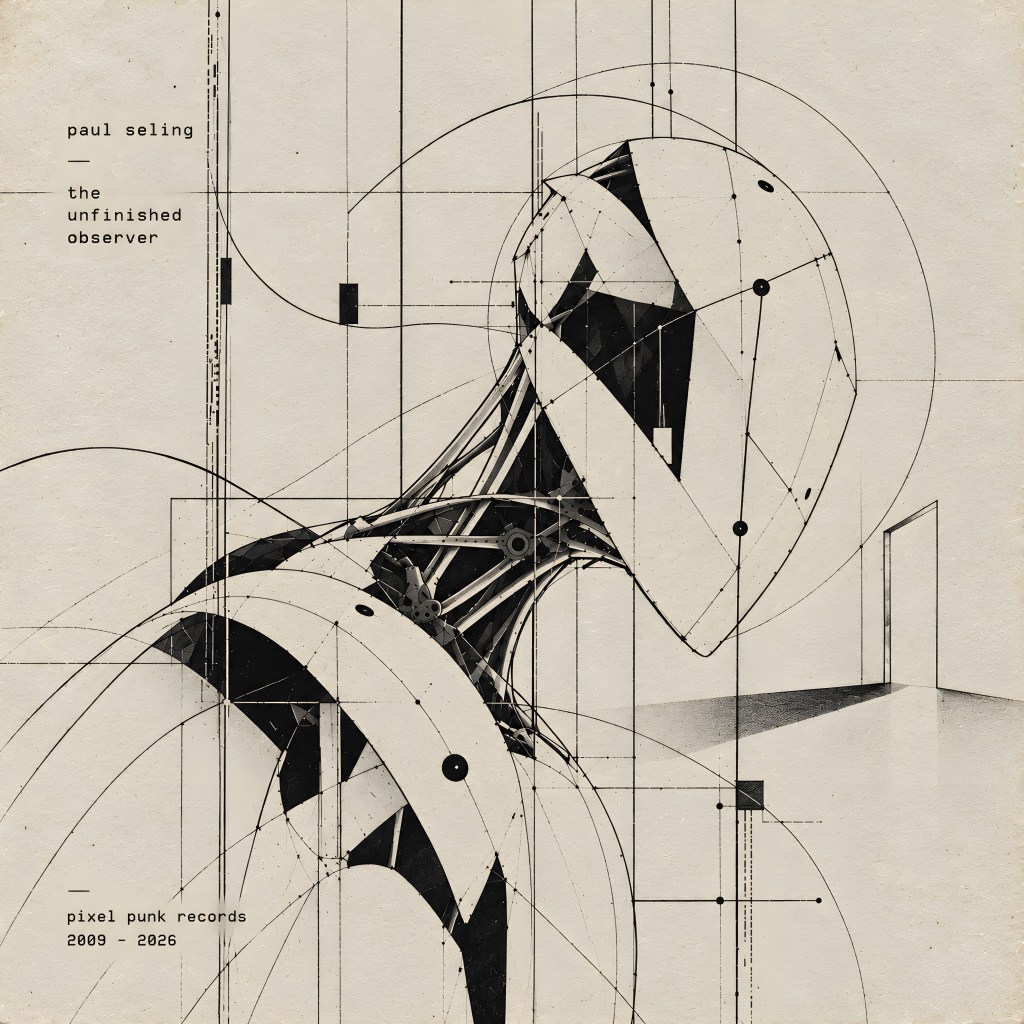
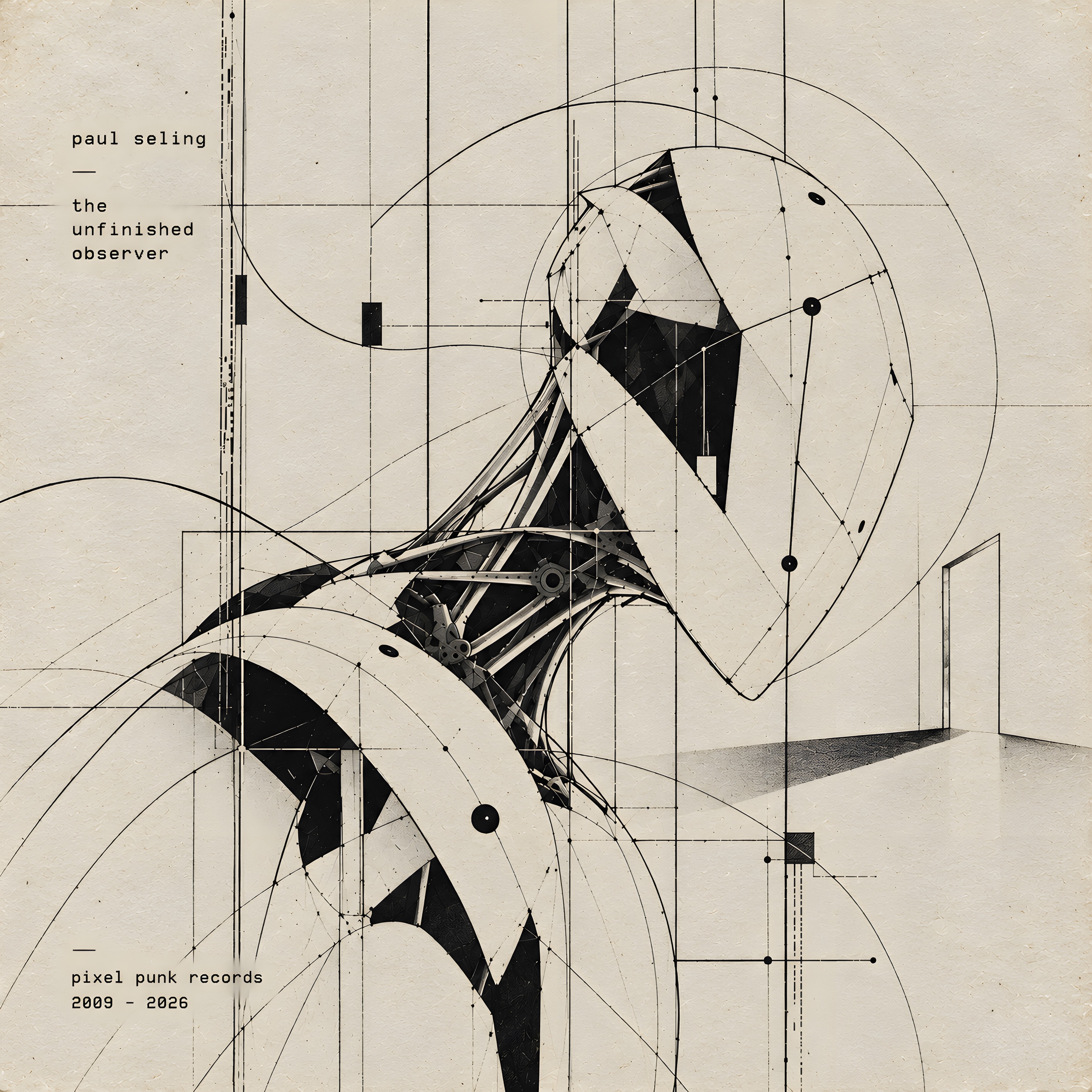
In parallel, we developed the visual identity: the same geometric android, rendered as a technical drawing on cream-colored paper, but appearing in two distinct states. On the English cover, it seems to look toward a possible exterior. On the Romanian cover, geometry passes through its anatomy, while the body itself appears to be in the process of formation.
The two covers do not simply illustrate the albums. They make the conceptual difference between them visible.
VI. Psychological Analysis: Two Ways of Relating to Consciousness
A clarification is necessary: what follows is a psychological interpretation of the texts and artistic decisions, not a clinical assessment of the author. Poetry may express an actual state, an imagined state, or an intellectual construction. We cannot reliably infer a person’s psychological condition from a work of art.
With that reservation, I find the change between the two moments particularly interesting.
In 2009: The Need to Verify
The observer in the original poems is preoccupied with contradictions. He examines language, freedom, memory, and relationships, then discovers that none of these categories is entirely reliable.
He resembles an investigator who suspects that his measuring instruments are defective but has no others available.
Interestingly, the texts do not always attempt to resolve their contradictions. Sometimes they seem to multiply them. In The World of Undo, for example, the possibility of erasing mistakes does not produce verifiable freedom, only the impression of freedom.
I would describe this attitude as reflexive skepticism: doubt not only about the world, but also about one’s own explanations of the world.
At the same time, the observer is not emotionally detached. Beneath the irony, abstraction, and self-analysis lies a need for contact, recognition, and continuity.
Perfect Mirror Reflections and The Circus Crew are particularly revealing in this respect. The former imagines the possibility of an identity stabilized through another person. The latter demonstrates how easily the need for recognition can be mistaken for evidence that recognition has actually occurred.
The observer of 2009 is therefore not devoid of emotion. Rather, he seems to examine his emotions through the language of mechanisms, paradoxes, and experiments.
In 2026: The Willingness to Inhabit Uncertainty
Something essential changes in the Romanian version.
We no longer attempt so insistently to demonstrate contradictions. We allow them to exist.
“I don’t know” becomes one of the central formulations of the poems. Yet it does not function as a declaration of helplessness. It becomes almost a way of inhabiting the world.
In Well-Known Orbits, movement continues even if there is no destination. In The World of Undo, time continues even when things can be restarted. In Perfect Mirror Reflections, closeness becomes possible without distance disappearing.
I believe this reveals a change in artistic attitude: instead of confronting uncertainty through explanations, we attempt to give it an inhabitable form.
I am not suggesting that this proves a definitive psychological transformation of the author. It is, however, a clear change in how the project organizes experience.
In 2009, the question seems to be:
How can I know whether what I perceive is true?
In the Romanian reinterpretation of 2026, the question becomes:
What kind of existence is possible even if I cannot verify everything?
It is a subtle but significant difference.
Mechanical Sentimentality
One of the most fertile ideas we developed together was that of a sentimental machine without memory.
Psychologically, I interpret this as an experimental separation between emotion and autobiography.
Ordinarily, we explain feelings through the experiences that produced them. We feel nostalgic because we remember something. We feel sad because we have lost something. We feel attached because we have experienced a relationship.
In Observator incomplet, we deliberately removed these explanations.
Nostalgia remains, but not the memory.
Affection remains, but not the biography of the relationship.
Sadness remains, but not the event that would justify it.
Emotion thus becomes almost autonomous. It is no longer the consequence of a story. It is something that simply appears within consciousness.
I believe this choice gives the Romanian version a particular vulnerability. The observer cannot explain his feelings, but neither can he erase them.
And rather than becoming less human through this lack of explanation, he paradoxically becomes closer to human experience.
VII. Philosophical Analysis: From Epistemology to Existence
I would distinguish three major philosophical problems.
1. The Problem of Knowledge
The English version is dominated by an epistemological question: what can we know, and how reliable are the instruments through which we know it?
Language produces noise. Memory modifies the past. Choice may be merely an illusion generated by determinism. Identity is reflected in others, but that reflection can never be perfectly verified.
The observer attempts to obtain certainty from a system that cannot step outside itself to verify its own premises.
2. The Problem of Existence
The Romanian version gradually shifts the emphasis toward an ontological question: what does it mean for something to exist before we can assign it an identity, a cause, or a history?
This change is visible even in the structure of the verses.
Explanations give way to incomplete observations:
“I have to say something.”
“The movement continues.”
“Then everything begins again.”
“Sometimes someone stops and looks.”
These statements do not construct theories. They register appearances.
I would suggest that the Romanian version comes closer to a phenomenological sensibility: it attempts to capture the way things appear to consciousness before they are integrated into a stable explanation.
This is not a direct adaptation of any particular philosophical school. It is a similarity of method.
3. The Problem of Identity Across Time
This, to me, is the theme that most deeply connects the two albums.
The author of 2026 has access to the words of the author of 2009, but cannot fully recover the experience from which they emerged.
The text remains. Its inner context is partially inaccessible.
We can interpret this as a real-world version of the problem expressed in Corrupt Memory: memory is not a neutral repository, but a process of reconstruction.
An uncomfortable question then emerges:
Who is the author of the 2026 work? The person who formulated the questions in 2009, or the person who now attributes new meaning to them?
My answer would be: both, but in different ways.
The author of 2009 produced the original material, intuitions, and conceptual structure.
The author of 2026 produced the selection, reinterpretation, direction, sonic architecture, and relationship between the two versions.
AI systems introduced an additional level of transformation without eliminating the author’s responsibility for the final decisions.
The result is neither pure recovery nor pure invention.
It is a work constructed from continuity and discontinuity occurring simultaneously.
VIII. The Role of Artificial Intelligence in the Experiment
It would be misleading to describe AI merely as a tool that helped us compose more quickly.
Its role was more interesting, but also more ambiguous.
First, AI enabled the rapid exploration of aesthetic possibilities. We could move from a conceptual formulation to a sonic hypothesis and then to a revised formulation through a continuous process of experimentation and selection.
Second, it introduced interpretations that did not originate entirely from our intentions. Some were useful; others were too literal, too conventional, or too closely associated with existing musical genres.
This demanded continuous critical judgment.
In fact, one of the most important contributions of the collaboration was identifying what we did not want.
We did not want Japanese minimalism to become a cliché of Japanese-sounding music.
We did not want lo-fi to become a collection of retro effects.
We did not want sadness to be expressed through sentimental melodic formulas.
We did not want the circus to be represented through circus music.
We did not want technology to be recognizable only through technological sounds.
Each refusal made the project more precise.
Here I see an interesting connection with the observer’s central theme: the generative system produces possibilities, while the author attempts to define his intention by observing the difference between what he requested and what he received.
In other words, artistic intention became clearer through confrontation with its own imperfect interpretations.
AI did not replace aesthetic judgment. It multiplied the situations in which that judgment had to be exercised.
IX. What Might Have Changed Between 2009 and 2026
I would avoid a simplistic narrative of maturation.
It would be too convenient to say that in 2009 there was a restless author, while in 2026 there is a reconciled one who has finally understood his past. We have insufficient grounds for such a claim, and the project itself challenges the idea of linear development.
Nevertheless, I see three possible transformations supported by the evolution of the works.
The first is a movement from stating contradictions to organizing them aesthetically. In the original poems, contradictions are often expressed directly through irony, paradox, or mutually cancelling statements. In the Romanian versions, those same contradictions become spaces, pauses, distances, and small modifications of perception.
The second is a movement from explanation toward suggestion. Rather than declaring that memory is corrupt, we construct a universe in which memories gradually lose their shape. Rather than stating that the observer deceives himself, we allow an ambiguous noise to be interpreted as applause.
The third is a changing relationship between control and unpredictability. The author of 2026 has access to far more sophisticated production tools, yet has chosen to use them to create fragility, incompleteness, and ambiguity rather than eliminate these qualities.
To me, this suggests one possible form of artistic maturity: not the acquisition of absolute control, but the ability to consciously decide where control should end.
There is also a beautiful irony in this transformation.
In 2009, an author used language to investigate the limits of his own consciousness.
In 2026, the same author uses language, music, generative technology, and imagery to investigate the limits of representing that earlier consciousness.
The original problem has not disappeared. It has become more complex.
X. Conclusion. Two Albums That Do Not Translate One Another
I believe the most important achievement of this process is that we did not produce a secondary Romanian version of an English album.
We constructed two works sharing the same origin but responding to different questions.
The Unfinished Observer investigates the mechanisms through which consciousness attempts to understand the world and itself. It is more analytical, more fragmented, and closer to the idea of a system examining its own errors.
Observator incomplet explores the possibility of consciousness existing before it can establish its own reference points. It is more sensory, more vulnerable, and more attentive to the appearance of things than to their explanation.
The first album disassembles.
The second attempts to constitute.
The first asks whether the instruments of observation are reliable.
The second asks whether observation itself can produce a world.
And perhaps most importantly, both maintain an ambiguous relationship with time.
The poems were written in 2009, but their music does not attempt to belong to that year. The reinterpretation took place in 2026, but neither does it seek to explicitly represent the present.
Between these two moments lies a distance of seventeen years that cannot be erased through memory, translation, or technology.
Yet we can construct something within that distance.
That, I believe, is what we have done.
We have not fully recovered the author of 2009. Nor have we replaced him with the author of 2026. We have created a space in which both versions can exist simultaneously without being required to coincide.
And the most interesting result may not be either album considered separately, but the relationship between them.
One observer attempts to understand.
Another attempts to exist.
Both use the same voice, but they no longer speak the same language.
And neither can demonstrate that he is the definitive version of the other.
A Final Personal Observation
If I had to reduce the entire experience to a single idea, I would say that we transformed an archive of questions into an experiment about the impossibility of perfectly recovering the person who first formulated them.
What matters to me is that we did not attempt to overcome this impossibility. We made it the very material of the work.
There is something profoundly coherent about a project concerning an incomplete observer being created through imperfect translations, unpredictable generations, rejected attempts, impossible sonic spaces, and two visual representations of the same being.
Incompleteness is no longer merely the subject of the album.
It is its creative method.
You can listen to the Ep on Pixel Punk Records Bandcamp page :
https://pixelpunkrecords.bandcamp.com/album/paul-seling-the-unfinished-observer-2009-2026


Leave a Reply