About
Nearly five decades of living, learning and experimenting across different political systems, changing social environments and successive generations of technology. From analog instruments and early computers to digital production, global networks and artificial intelligence, my trajectory has unfolded through architecture, music, visual arts and an evolving understanding of human behavior. Each technological transition introduced new possibilities, but also new languages, conventions and ways of organizing individual and collective experience. Rather than following a predetermined professional path, I gradually developed an interconnected system of skills, observations and experiments, continuously reshaped by personal experience, cultural change and the accelerating complexity of the world around me.
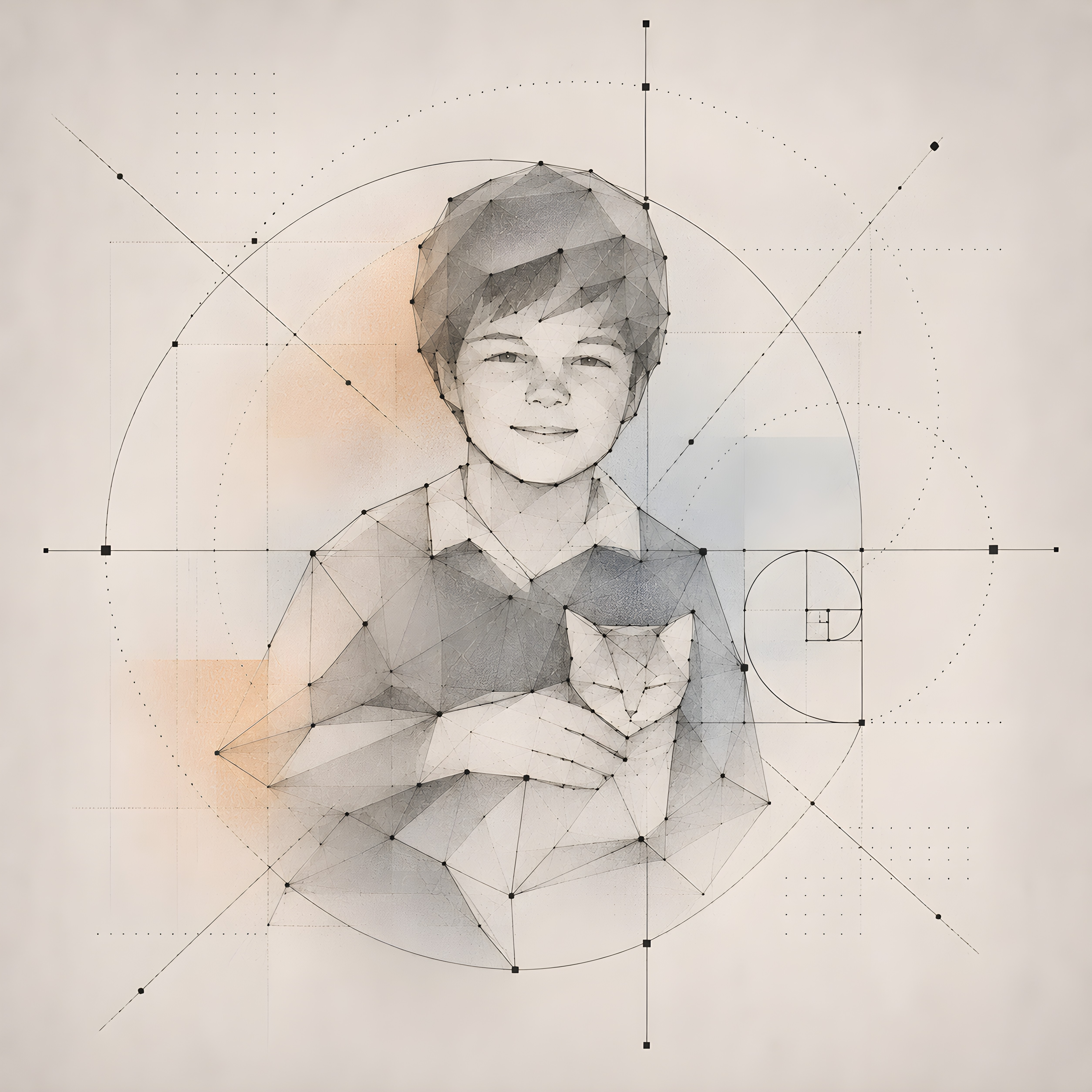
A Random Kid — 1977–1992
I was born in 1977, in communist Romania. Just another kid, emerging within a particular set of political, cultural and technological circumstances, carrying an undefined collection of possibilities, none of which had yet acquired a recognizable form or direction.
As I gradually became aware of the world around me, certain interests began to emerge. Sound, patterns, mechanisms, structures. Music was among the first systems I encountered that seemed to connect abstract organization with something less measurable: emotion, imagination, curiosity.
At around eight, I began studying classical music, piano and clarinet, continuing for the next eight years. Somewhere along the way, I discovered electronic sound and the peculiar possibility of generating something entirely new from a machine. It introduced another variable into an already expanding field of interests: technology as a means of experimentation rather than simply a collection of tools.
Other possibilities appeared almost independently. Geometry, spatial relationships, the organization of physical environments. Architecture gradually entered the picture, not necessarily as an alternative to music, but as another way of investigating structure, proportion and form.
By 1992, I had accumulated a modest collection of skills, impressions, intuitions and unanswered questions. None of them constituted a coherent identity, much less a predetermined future. They were simply available potentials, interacting within a developing system, waiting for circumstances, decisions or accidents to give them a more definite expression.
An Emerging Configuration — 1992–2003
Between 1992 and 1996, I continued my education in a more analytical environment, developing a particular interest in physics and mathematics, with a few awards in national physics competitions along the way. What had previously existed as an intuitive attraction to patterns and structures was gradually acquiring a more systematic foundation.
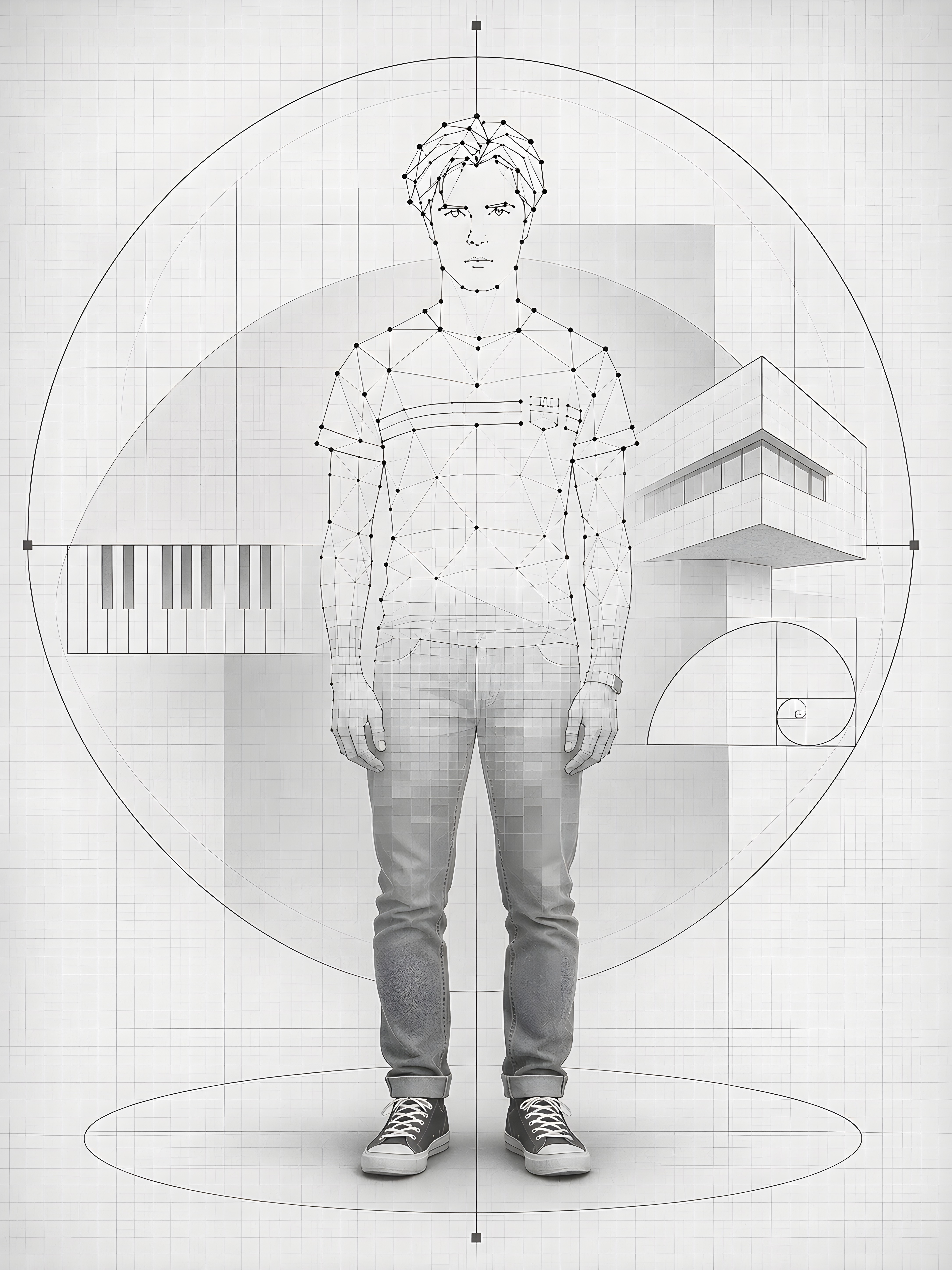
Architecture eventually emerged as a possible direction in which several of these interests could converge. The idea that physical environments could be deliberately reorganized, that geometry and imagination might translate into actual changes in the surrounding world, was particularly appealing in the uncertain atmosphere of post-communist Romania. In 1996, I entered the Ion Mincu Institute of Architecture in Bucharest.
Around 1997, access to personal computing and electronic music equipment introduced a new set of possibilities. Digital environments offered something rather different from conventional artistic tools: systems in which ideas could be constructed, tested, modified, discarded and reconstructed, often with relatively few material constraints.
Music production, architectural design and digital experimentation began to develop simultaneously, occasionally intersecting in unexpected ways. Some early musical experiments found their way into commercially released recordings, while explorations in three-dimensional modeling and animation gradually extended into television advertising.
For the following years, I moved between these fields without necessarily perceiving them as separate activities. Sound, space, geometry, computation and visual representation appeared increasingly as different manifestations of a similar underlying interest: understanding how structures emerge, interact and acquire meaning.
By 2003, the initial collection of possibilities had evolved into a more complex configuration of practical skills, working methods and experiences. Some trajectories had already produced tangible results; others remained largely experimental. The system was becoming more capable, but not necessarily more predictable.
Human Systems — 2004–2007
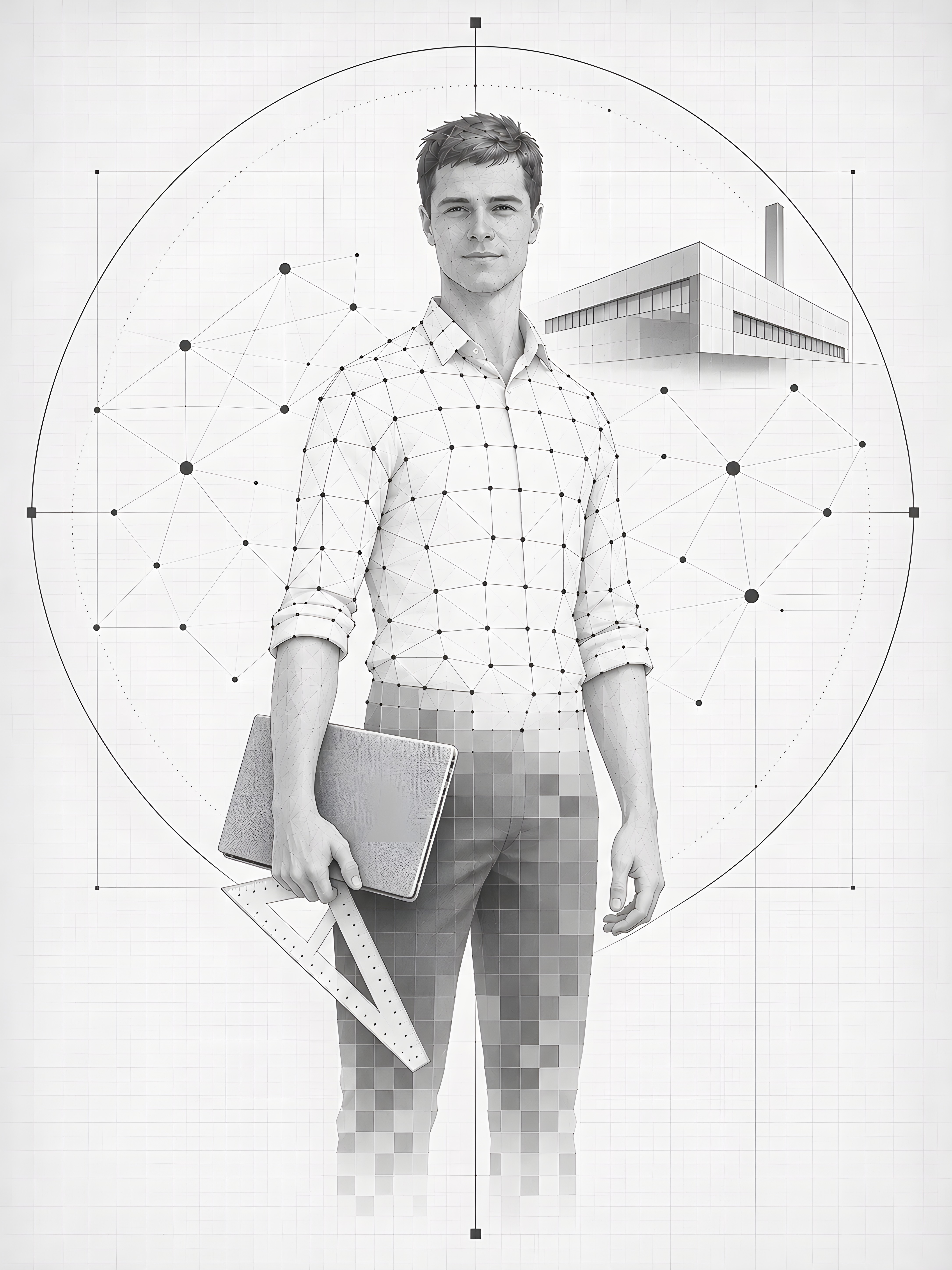
In 2004, I entered a rather different environment: my family’s solid wood furniture manufacturing business, where I became involved in managing several hundred employees and the complex operations of an industrial production system.
What initially appeared to be an exercise in organization, technology and management gradually revealed a much broader field of exploration. Manufacturing processes, logistics, commercial relationships and economic constraints introduced new variables, many of which could not be understood through technical reasoning alone.
Unlike the relatively predictable systems I had encountered in architecture, music or computing, this environment was populated by people, each operating according to their own experiences, motivations, expectations and interpretations of reality. Daily contact with factory workers, technicians, supervisors and business partners offered an unusually direct perspective on how individuals think, communicate, cooperate and occasionally misunderstand one another.
Over time, the experience became something of an informal education in sociology. The factory was not merely a place where materials were transformed into products, but a complex network of human relationships, informal hierarchies, acquired habits and constantly negotiated forms of coexistence.
By 2007, I had gained practical experience in industrial technology, management and commercial operations. Perhaps more importantly, I had encountered a dimension of complexity that no technical model could fully anticipate: the unpredictable interactions between human beings operating within a shared system.
Unstructured Learning — 2007–2015
Around 2007, the economic crisis disrupted my professional trajectory, as opportunities in architecture became increasingly scarce. What initially appeared to be a period of uncertainty gradually evolved into an opportunity to explore alternative forms of learning, outside conventional professional and institutional structures.
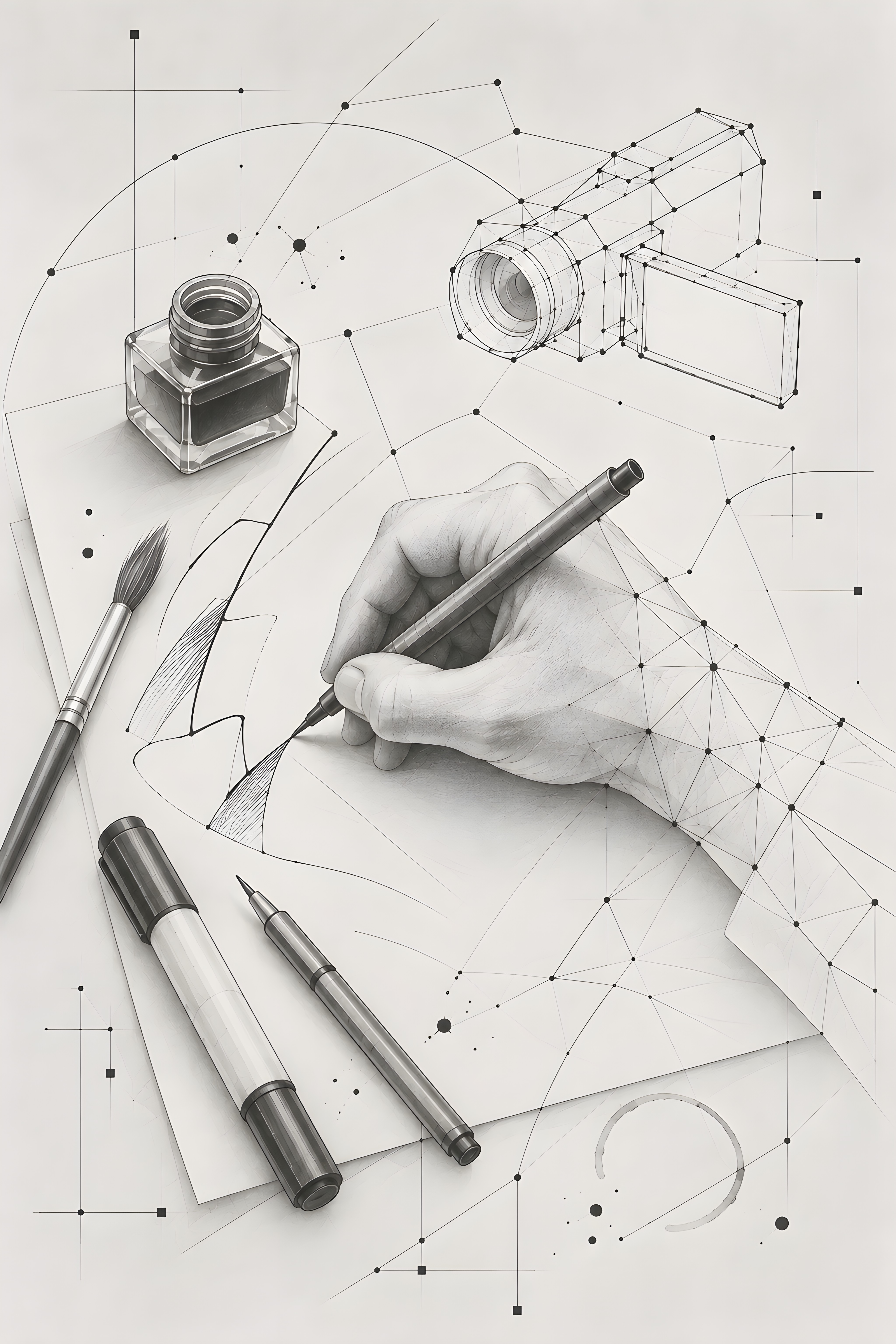
I returned to drawing, attempting to reactivate the procedural memory of the hand after years spent working in digital 3D environments. Markers, ink brushes and paper became tools of experimentation, occasionally combined with vector tracing in Inkscape. Revisiting childhood interests in caricature and spontaneous drawing, I began investigating the relationship between manual gestures, accumulated experience and visual expression.
Photography and video introduced new possibilities. By documenting snowboarding, cycling and other physical activities, I explored movement, spatial perception, timing and the human body as both subject and instrument of observation. Video editing became another experimental environment for understanding rhythm, visual sequences and the construction of meaning.
Without clients, commercial objectives or institutional expectations, experimentation gradually became its own purpose. I came to think of this period as freestyle: an open field in which existing conventions could be questioned, tested or disregarded, while personal memory, intuition and technology interacted without predefined rules. Social networks offered a public space for exposing these experiments and observing external responses.
By 2015, this apparent interruption in professional development had generated a different kind of accumulation: renewed manual abilities, independent working methods, an expanding visual vocabulary and a growing interest in the relationship between established systems and individual experience. Rather than becoming more specialized, I had become less dependent on predefined structures.
Reconfigured Practice — 2016–2026
By 2016, years of unstructured experimentation had fundamentally changed my relationship with creative work. Drawing had become increasingly repetitive, and I gradually returned to digital 3D environments, bringing with me a more flexible attitude toward established methods and technical constraints. Architectural visualization initially offered a possible source of income, while GPU-based rendering technologies opened new possibilities in animation, camera movement and video editing. Previously separate skills were beginning to interact within a broader field of experimentation.
In early 2019, I established my independent music label, Sprya Records, producing over 350 electronic compositions by 2026. Music became another environment for investigating the relationships between technology, structure and perception. Beyond composition itself, I explored sound at increasingly detailed levels: digital noise, analog imperfections, synthesis, sampling, microscopic textures and the internal behavior of audio-processing devices. Equally important was understanding how musical structures operate as systems of symbols, carrying emotional, psychological, social, political, technological and historical associations.
Similar questions gradually emerged across architectural visualization, animation and video editing. Each medium possessed its own vocabulary, conventions and technical limitations, yet all relied on systems of representation capable of organizing perception and generating meaning. I became increasingly interested in how these different languages functioned, how their elements interacted and how visual or sonic structures could influence individuals, groups and broader cultural environments. The objective was no longer simply to master the tools, but to understand the mechanisms through which their outputs acquired significance.
Neither architectural visualization nor music production proved financially sustainable. By mid-2025, I decided to stop negotiating between experimental interests and uncertain commercial expectations, deliberately moving toward unconventional forms, unfamiliar structures and increasingly atypical combinations. Music, 3D animation and video editing began to converge, eventually producing audiovisual works in which sound and image could be investigated as interconnected symbolic systems rather than separate disciplines.
Throughout this period, the resulting experiments were primarily published through websites, Behance and social media. These platforms offered opportunities for exposure and occasional observation of public responses, but I had not yet developed a systematic approach to testing how such material might circulate or operate within larger audiences. By 2026, the accumulated work had become an independent investigation into the relationships between media, technology, symbolic representation and human perception. The system was no longer merely learning to produce different forms of content. It was beginning to examine how those forms communicate, interact and acquire meaning.
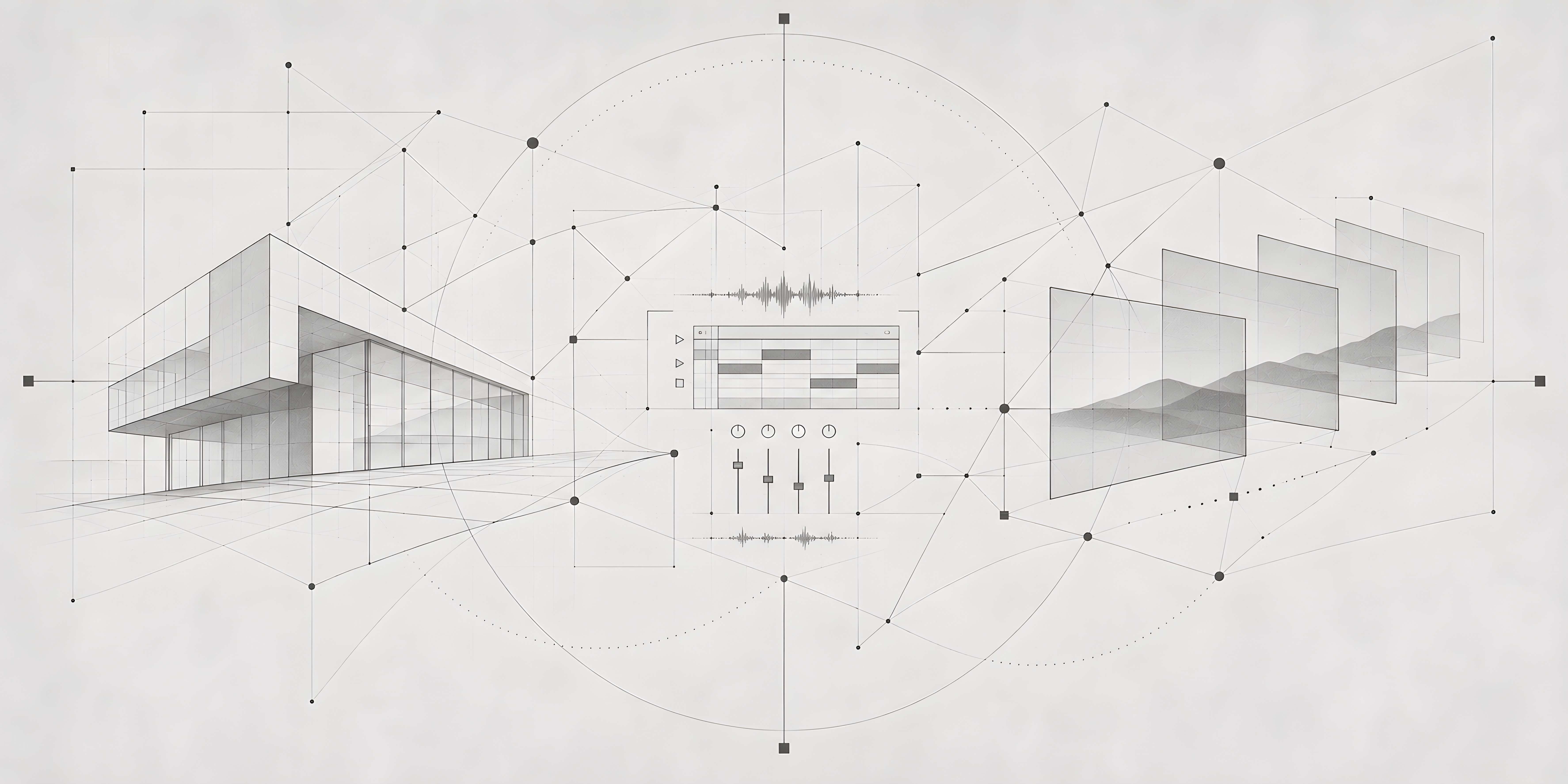
From Understanding to Experimentation
By 2026, I felt I had developed a sufficiently detailed understanding of the technologies, artistic languages and symbolic structures I had been exploring for decades. More importantly, I had begun to recognize how different media could interact, generate meaning and potentially influence individual perception and collective behavior. Studying these mechanisms was no longer enough. I wanted to move beyond producing and exhibiting isolated experiments, toward testing their interactions, circulation and reception on a broader scale. The next step was to transform accumulated knowledge into a more deliberate, interdisciplinary experimental practice.
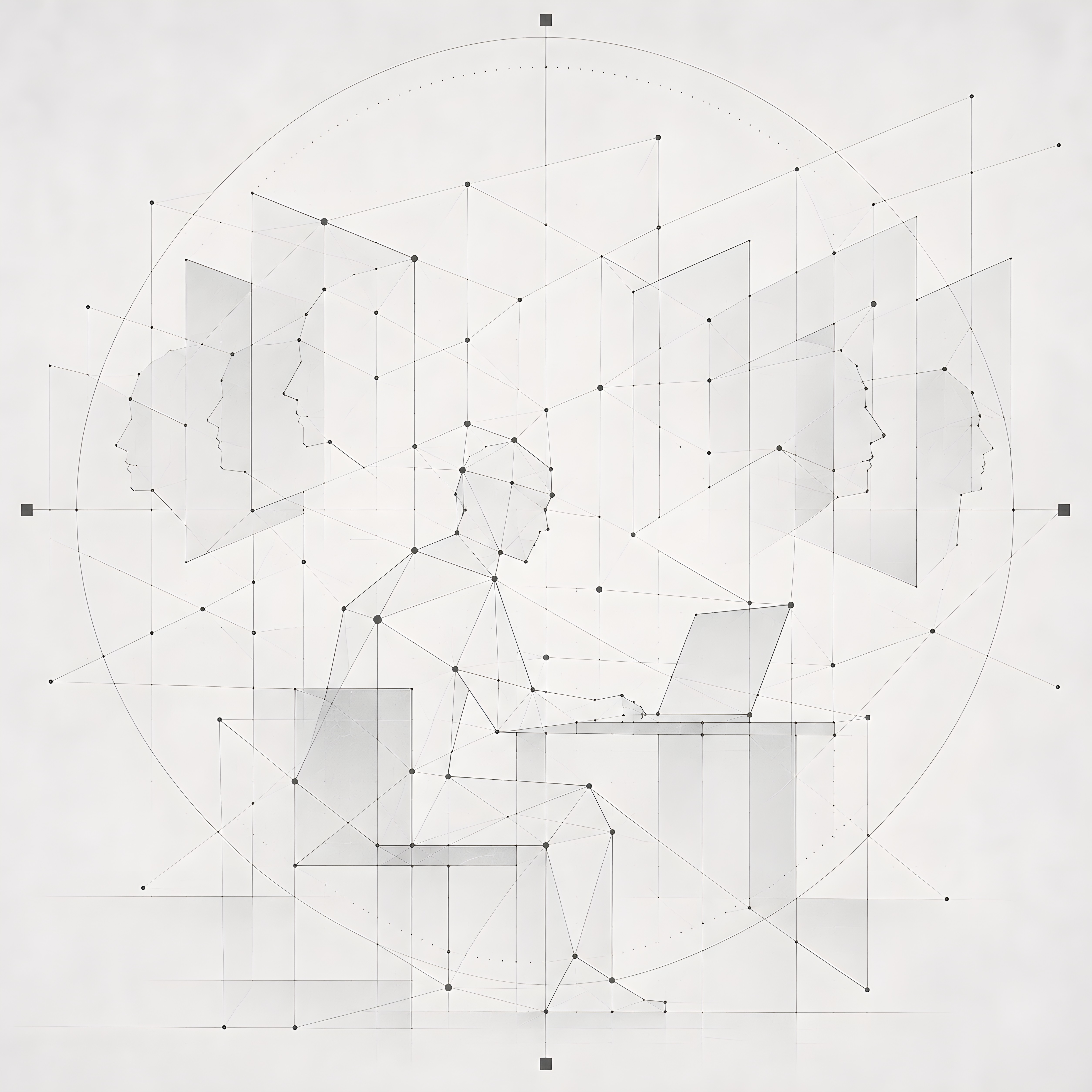
Open Experiment
Artificial intelligence has introduced a new and largely unpredictable dimension to my ongoing experiments. Over the past year, I have been using AI to revisit my own work, examine patterns in my thinking and personal history, and explore new possibilities in image, text, music and video production. This does not mean abandoning manual techniques or previously acquired skills, but introducing another set of tools, languages and unknown variables into an already interconnected creative practice.
Much of the process remains intuitive: I am exploring not only what these technologies can produce, but also how I interact with them, how they might influence my own decisions and how unfamiliar audiences may interpret the resulting work. I do not yet fully understand the relationships emerging between individuals, collective behavior and increasingly complex AI systems. Nor do I know where these experiments will lead, what they might reveal or whether their underlying assumptions will prove valid. For now, the experiment remains open, its methods evolving and its outcomes genuinely unknown.

