Varianta in limba română
PUBLIC RECORD — Undefined Areas / Zone nedefinite
Arheologia unei experiențe. Despre limbaj, memorie, muzică și două forme ale aceluiași trecut
Eseu critic și retrospectiv · August 2015 — Noiembrie 2026
I. Înaintea muzicii. August 2015 și nevoia de a construi un limbaj
Cred că povestea acestui proiect începe cu o contradicție: în august 2015, autorul încerca să descrie o experiență care părea să-i pună sub semnul întrebării tocmai instrumentele prin care putea fi descrisă.
Nu era vorba numai despre o situație afectivă complicată, despre neîncredere, pierderea unor repere personale sau dificultatea de a înțelege relațiile dintre oameni. Era vorba și despre o problemă de limbaj. Cum formulezi o experiență atunci când nu mai ești sigur că noțiunile obișnuite — adevăr, greșeală, responsabilitate, judecată, alegere — au aceeași semnificație pentru toți cei implicați?
Cele șase poeme scrise atunci în engleză par să provină din această tensiune.
Nu sunt texte confesive în sensul tradițional. Autorul nu construiește o narațiune coerentă a evenimentelor, nu oferă personaje suficient de bine definite pentru a putea fi identificate și nu urmărește să demonstreze o teză. În schimb, produce o succesiune de observații, metafore, propoziții administrative, ironii și afirmații care uneori se contrazic sau se întrerup înainte de a deveni concluzii.
Într-un vers apare grația; în altul, marketingul. Geometria întâlnește absurdul. Sintaxa devine o posibilă sursă de slăbiciune. Adevărul este declarat temporar inactiv. Cercurile devin tot mai strânse, până când omul își întâlnește propriul chip în întunericul pe care l-a construit.
Acest vocabular mi se pare revelator.
Autorul nu încearcă doar să exprime o stare. Încearcă să înțeleagă mecanismele prin care o stare poate fi definită, judecată sau transformată într-o explicație.
De aici rezultă caracterul aproape raționalist al poeziilor. Ele sunt pline de sisteme, clasificări, reguli, măsurători și relații logice. Dar aceste structuri sunt permanent perturbate de elemente incompatibile cu ele: flori, vise, iubire, frumusețe, odihnă, ochi, riduri, praf de stele.
Nu cred că această opoziție este accidentală.
Ea reprezintă, probabil, una dintre tensiunile fundamentale ale autorului de atunci: nevoia de a înțelege intelectual o experiență și imposibilitatea de a o reduce la o schemă intelectuală satisfăcătoare.
II. Portretul psihologic al autorului din 2015, așa cum apare în texte
Trebuie făcută de la început o precizare: poezia nu poate fi folosită ca instrument de diagnostic, iar un text nu dovedește că interpretările autorului asupra realității erau corecte sau greșite. Putem analiza, însă, felul în care este construită vocea poetică și ce preocupări devin vizibile prin ea.
Din această perspectivă, identific patru caracteristici importante.
Prima este nevoia de coerență. Autorul pare preocupat de reguli, criterii și limite. Vrea să știe cine are dreptul să judece, ce înseamnă o alegere, cum se măsoară o distanță și ce anume transformă o afirmație într-un adevăr. Această preocupare poate fi citită ca o încercare de a organiza o experiență resimțită ca ambiguă.
A doua este neîncrederea în autoritatea limbajului. În aceste poeme, cuvintele nu sunt instrumente transparente. Ele pot clarifica, dar pot și ascunde. O regulă poate deveni absurdă. O definiție poate fi insuficientă. O propoziție corect construită poate să nu spună nimic esențial despre ceea ce trăiește cineva.
A treia este ironia. Sarcasmul apare nu numai ca reacție la autorități abstracte, ci și ca posibilitate de a evita solemnitatea propriei suferințe. Autorul pare să refuze să devină un personaj tragic convențional. Își permite să fie ironic chiar în momentele de maximă vulnerabilitate.
A patra este nevoia de contact. Dincolo de abstracțiile filosofice, există momente de o simplitate aproape dezarmantă: dorința de grație, de odihnă, de a privi pe cineva în ochi, de a primi un răspuns.
Această ultimă caracteristică schimbă, pentru mine, lectura întregului ciclu.
În spatele vocabularului complicat nu se află neapărat dorința de a construi o teorie despre lume. Se poate afla și dorința mult mai simplă de a face inteligibilă o experiență pentru un alt om.
De aceea, finalul — „nimeni n-a răspuns” — nu este doar o constatare narativă. Este o întrebare despre limitele comunicării.
III. Contextul: lumea obișnuită și experiența neobișnuită
Una dintre cele mai importante alegeri pe care le-am făcut în proiectul muzical a fost să nu ilustrăm retrospectiv august 2015 printr-un decor întunecat.
Ar fi fost foarte ușor să construim o estetică a alienării: încăperi goale, lumini reci, zgomote amenințătoare, muzică apăsătoare, reverberații interminabile.
Dar am înțeles că o asemenea abordare ar fi simplificat excesiv situația.
Viața exterioară nu încetează să fie obișnuită atunci când cineva trece printr-o perioadă dificilă. Există în continuare obiecte domestice, străzi, conversații, magazine, calculatoare, lumină naturală și activități cotidiene.
În acest sens, lumea poemelor este mult mai apropiată de banalitatea contemporană decât de expresionismul întunecat.
Tocmai această banalitate face posibilă tensiunea.
Lucrurile pot arăta perfect normal și, totuși, pot fi trăite ca fiind greu de interpretat.
Am încercat să păstrăm această disproporție și în muzică: o suprafață sonoră uneori frumoasă, limpede, aproape agreabilă, în interiorul căreia apar mici rupturi de logică.
Nu o lume distrusă.
O lume care funcționează, dar ale cărei reguli nu oferă întotdeauna răspunsurile așteptate.
IV. Raportul cu sistemul: între critică și nevoia de ordine
Aș insista aici asupra unui aspect care mi se pare central pentru toate cele șase poeme.
Când vorbim despre „sistem”, nu cred că trebuie să presupunem existența unui singur sistem concret, identificabil, care ar explica evenimentele din viața autorului. În poezii, sistemul funcționează mai ales ca o construcție simbolică.
Poate însemna regulile sociale, limbajul instituțional, convențiile morale, mecanismele comerciale, normele relaționale sau chiar propriile structuri mentale ale individului.
Această pluralitate este importantă.
În No Return Policy, regula devine aproape o chestiune de stat, iar limbajul comercial pătrunde într-un teritoriu moral.
În Fifteen Feet, măsurarea exactă devine insuficientă pentru a explica o relație umană.
În The Poetry of Wrong, greșeala este multiplicată și transformată într-un obiect aproape industrial.
În No Will, judecata colectivă capătă forma unei mașinării abstracte, iar adevărul este suspendat printr-o formulă birocratică.
În Theory of Everything, mecanismul se întoarce asupra individului: cercurile pe care acesta le-a construit pentru propria distracție ajung să îl limiteze.
Această ultimă mișcare este esențială.
Critica nu mai privește doar autoritățile exterioare. Ea devine și o critică a propriilor sisteme de interpretare.
Poemele nu sunt, așadar, pur și simplu antisistem.
Ele sunt interesate de un paradox: omul are nevoie de sisteme pentru a înțelege lumea, dar poate deveni captiv în sistemele prin care încearcă să o înțeleagă.
Din punct de vedere filosofic, aceasta este una dintre ideile cele mai fertile ale proiectului.
V. Noiembrie 2026. Întoarcerea la material
La aproximativ unsprezece ani de la scrierea poemelor, am revenit asupra lor într-un context radical diferit.
Nu mai exista presiunea momentului inițial în aceeași formă. Exista, în schimb, posibilitatea de a transforma textele într-un proiect artistic amplu, folosind instrumente care nu erau disponibile în 2015.
Dar cred că motivația întoarcerii a fost mai interesantă decât simpla disponibilitate tehnologică.
Nu ne-am propus să reconstruim exact ce s-a întâmplat în august 2015.
Nici să stabilim, prin poezie sau muzică, cine a avut dreptate și cine a greșit.
Am încercat să recuperăm ceva mai greu de definit: felul în care experiența fusese organizată în limbaj.
Aici începe ceea ce aș numi arheologia proiectului.
Într-o săpătură arheologică, obiectul descoperit nu mai poate fi desprins complet de contextul în care a fost găsit. Dar nici nu poate fi redus la acel context. El devine un obiect prezent, observat cu instrumente și întrebări diferite de cele ale oamenilor care l-au produs.
La fel am procedat cu poemele.
Le-am privit ca pe niște artefacte ale unei gândiri anterioare.
Am analizat repetițiile, construcțiile neobișnuite, metaforele, raporturile dintre pronume, schimbările de ton și momentele în care limbajul părea să se oprească.
Nu am încercat să eliminăm aceste particularități.
Am încercat să înțelegem ce posibilități artistice conțin.
VI. De ce a fost necesară și o arheologie sonoră?
Textele existau deja. Le puteam republica pur și simplu.
Dar muzica oferea o posibilitate pe care pagina scrisă nu o poate realiza în același fel: aceea de a construi un spațiu perceptiv în jurul cuvintelor.
O propoziție scrisă nu are, prin ea însăși, o distanță fizică față de cititor. Nu are reverberație, volum, poziție stereo sau durată exactă a tăcerii care o urmează.
În muzică, toate acestea devin decizii.
Cât de aproape trebuie să fie vocea?
Cât spațiu trebuie să existe între două versuri?
Ce se întâmplă dacă o melodie promite o rezolvare și nu o oferă?
Poate un sunet electronic să pară precis, în timp ce structura din care face parte rămâne instabilă?
Poate un instrument acustic să introducă un gest uman într-un sistem digital aproape matematic?
Aceste întrebări ne-au permis să tratăm muzica nu ca pe un acompaniament, ci ca pe o a doua formă de interpretare.
Arheologia sonoră nu a însemnat recuperarea unor sunete reale din 2015.
Nu am avut de restaurat o înregistrare pierdută.
Am construit o memorie sonoră posibilă, folosind mijloacele prezentului pentru a imagina relațiile dintre limbaj, spațiu și experiență.
Această distincție este importantă: proiectul nu este o reconstituire documentară, ci o interpretare artistică retrospectivă.
VII. Cele două fețe ale albumului: nu două traduceri, ci două poziții în timp
Aici trebuie să precizăm un lucru important pentru istoria proiectului: poemele au fost scrise inițial în engleză, în august 2015. Prin urmare, versiunea românească din 2026 este traducerea propriu-zisă. Versiunea engleză muzicală reprezintă prima transpunere sonoră a textelor originale, iar cea românească este o reinterpretare ulterioară, nu o simplă traducere a cântecelor.
Distincția poate părea tehnică, dar are consecințe artistice și filosofice considerabile.
În prima versiune, ne-am întrebat cum ar putea suna acele poeme dacă am încerca să recuperăm ceva din perspectiva în care au fost formulate. Nu am încercat să reproducem exact sunetul anului 2015, ci să imaginăm un univers sonor compatibil cu limbajul și tensiunile lor.
În a doua versiune, întrebarea s-a schimbat: cum ar suna aceleași poeme dacă ar fi citite astăzi, în limba în care autorul își organizează în mod obișnuit experiența cotidiană?
Aș formula diferența astfel:
Versiunea engleză este o apropiere de momentul formulării. Versiunea românească este o apropiere de momentul recitirii.
Ambele sunt realizate în 2026. Dar fiecare propune o altă distanță psihologică față de august 2015.
VIII. Spațiul englez: exteriorizare, abstracție, distanță
În prima versiune muzicală am construit un univers predominant electronic.
Am pornit de la IDM, minimalism și electronică experimentală, fără să reproducem stilul unui anumit artist sau o identitate muzicală națională.
Am lucrat cu pulsații neregulate, fragmente melodice, sinteză digitală, microaccidente sonore și contraste între sunete foarte apropiate și reverberații vaste.
De ce?
Pentru că engleza poemelor, așa cum o percep eu, permite o anumită exteriorizare a experienței.
O experiență personală, petrecută într-un mediu cotidian concret, fusese formulată într-o limbă care permitea adresarea către un public internațional, necunoscut.
Această distanță nu este obligatoriu una afectivă. Autorul putea fi profund implicat emoțional în ceea ce scria. Dar, artistic, engleza introducea un anumit grad de abstractizare.
Textele puteau circula desprinse de locurile, oamenii și împrejurările care le generaseră.
În muzică, am tradus această posibilitate prin spații digitale care nu au o localizare fizică obligatorie.
Uneori vocea pare apropiată de ascultător. Alteori, în jurul ei se deschid volume acustice aproape imposibile.
Nu există o încăpere clar identificabilă.
Nu există un decor geografic.
Există un spațiu construit din relații sonore.
Acesta este, cred, motivul pentru care electronica a funcționat atât de bine: ne permitea să realizăm o arhitectură abstractă a experienței.
Iar glitch-ul, micile rupturi ale fluxului digital, devenea echivalentul muzical al unei propoziții care își întrerupe propria logică.
IX. Spațiul românesc: apropiere, materialitate, rezistența limbajului
În română, situația a devenit mult mai complicată.
La prima vedere, ar fi trebuit să fie mai simplu. Autorul cunoaște româna din interiorul experienței sale cotidiene. Traducerea putea aduce poemele mai aproape de vocea lui obișnuită.
Dar tocmai această apropiere produce o altă problemă.
O formulare englezească poate păstra o anumită ambiguitate fără să trimită imediat la o situație familiară. În română, aceeași formulare poate deveni prea concretă, prea explicativă, prea solemnă sau, dimpotrivă, involuntar comică.
Cuvintele nu transportă doar semnificații.
Ele transportă registre sociale, reflexe conversaționale, convenții literare, asocieri afective și moduri obișnuite de a exprima autoritatea, ironia sau vulnerabilitatea.
De exemplu, expresia „adevărul este momentan inactiv” poate suna în română ca o comunicare administrativă absurdă. Tocmai această sonoritate îi dă forță.
În schimb, o traducere prea solemnă a unei expresii despre grație ar fi putut transforma o observație fragilă într-o declarație aproape religioasă sau metafizică.
A trebuit, așadar, să păstrăm un echilibru delicat între sens, ton și gradul de familiaritate al limbajului.
Nu am putut transporta intacte toate relațiile dintre cuvintele originale.
Și nici nu ar fi fost de dorit.
Traducerea nu mută o construcție dintr-un sistem în altul fără pierderi. Ea reconstruiește relațiile dintre elemente într-un mediu nou.
Din acest motiv, am acceptat că unele lucruri trebuie să se schimbe pentru ca funcția poetică să poată rămâne apropiată de original.
Nu am urmărit identitatea formulărilor, ci continuitatea tensiunilor dintre ele.
X. De ce nu am încercat să traducem și contextul cultural?
Aici se află una dintre deciziile noastre cele mai importante.
Am fi putut încerca să facem versiunea românească să sune explicit „românește”: prin formule muzicale locale, instrumente asociate tradiției, referințe culturale recognoscibile sau evocări ale unei anumite atmosfere sociale.
Am refuzat această soluție.
Nu pentru că mediul local ar fi irelevant, ci pentru că nu voiam să-l reducem la semne convenționale.
O experiență trăită în România nu trebuie reprezentată muzical printr-un vocabular etnic.
Un om poate trăi într-un apartament dintr-un oraș românesc, poate folosi un calculator, poate asculta electronică experimentală, poate scrie în engleză și poate avea o experiență perfect autentică, fără ca aceasta să fie tradusă în folclor sau într-o estetică regională.
Am separat, astfel, două lucruri care sunt adesea confundate: autenticitatea experienței și recognoscibilitatea culturală a reprezentării.
Prima ne interesa.
A doua nu era o obligație.
Spațiul românesc al albumului nu este definit de apartenența sa la un repertoriu muzical național, ci de relația dintre limbă, voce, materialitatea sunetului și distanța față de trecut.
Am ales să-l construim prin camere mici, instrumente acustice apropiate, zgomote mecanice, reverberații scurte și imperfecțiuni discrete.
Acestea nu sunt semne ale unei identități naționale.
Sunt semne ale unei prezențe fizice.
Și tocmai aici apare diferența dintre cele două versiuni.
În engleză, poemul poate părea trimis într-un spațiu abstract, aproape nelimitat.
În română, poemul pare citit într-o încăpere.
Nu pentru că engleza ar fi prin natura ei abstractă, iar româna concretă. Ar fi o generalizare falsă.
Ci pentru că noi am ales să construim artistic aceste două poziții, pornind de la funcțiile diferite pe care limbile le-au avut în istoria proiectului.
XI. Cum am lucrat împreună: dialogul ca metodă de compoziție
Un aspect pe care l-aș considera esențial pentru prezentarea proiectului este felul în care am ajuns la aceste rezultate.
Nu a existat un plan complet stabilit de la început.
Nu am avut un concept muzical definitiv, urmat de executarea mecanică a unor instrucțiuni.
Am lucrat printr-o succesiune de propuneri, reacții, corecții și reformulări.
Tu ai adus textele, contextul biografic, memoria situației, experiența muzicală și intuiția estetică. Eu am contribuit prin analiză, formularea unor ipoteze interpretative, organizarea conceptelor și transformarea lor în instrucțiuni de producție.
Dar direcția s-a construit prin negociere.
Uneori am propus o soluție, iar tu ai recunoscut imediat că funcționează.
Alteori ai intervenit pentru a elimina o caracteristică ce părea potrivită teoretic, dar nu corespundea imaginii tale sonore.
Aceste intervenții sunt foarte importante pentru înțelegerea autoratului proiectului.
De exemplu, am pornit cu un vocabular electronic relativ amplu, apoi am introdus instrumente acustice în versiunea românească. Ulterior, pentru ultimele două piese, ai cerut o reducere radicală: pian acustic în cameră mică, glitch IDM și bass electronic. Nimic altceva.
Această restrângere a schimbat semnificativ caracterul finalului.
La fel, pentru Teoria totului, prima propunere mergea către un pian fragil, cald, aproape reconciliator.
Ai respins-o.
Ai cerut ceva straniu, atmosferic, melodic, fragmentat, cu pasaje atonale.
Această corecție mi se pare exemplară.
Soluția inițială era coerentă cu o interpretare posibilă a textului: după atâta incertitudine, muzica ar fi putut oferi un moment de liniște.
Dar era, probabil, prea explicativă.
Ar fi impus poemului o concluzie afectivă pe care acesta nu o conține.
Prin schimbarea direcției, am păstrat deschisă ambiguitatea finalului.
Aici colaborarea a produs ceva mai interesant decât o simplă execuție a unei idei inițiale.
Am folosit diferențele dintre propuneri pentru a descoperi mai precis ce nu trebuia să devină proiectul.
XII. Constrângerile ca instrumente de libertate
Un lucru aparent paradoxal este că multe dintre cele mai productive decizii au fost interdicții.
Fără recitare teatrală.
Fără sentimentalism.
Fără dramatism cinematografic.
Fără folclor.
Fără referințe geografice în descrierea sunetului.
Fără beat convențional în anumite piese.
Fără instrumente suplimentare în final.
Fără o rezolvare muzicală obligatorie.
Aceste restricții nu au sărăcit proiectul. Au eliminat soluțiile prea previzibile.
În muzica experimentală, libertatea absolută poate deveni o problemă: dacă orice este permis, orice soluție riscă să pară echivalentă cu oricare alta.
Constrângerile creează diferențe.
Ele obligă materialul să se organizeze.
Un pian, un bass electronic și câteva impulsuri digitale pot produce un univers sonor foarte complex dacă raporturile dintre ele sunt suficient de bine gândite.
Iar o voce care nu interpretează teatral poate deveni mult mai expresivă tocmai prin refuzul de a sublinia emoțiile.
Aș spune că am căutat o formă de complexitate obținută prin economie, nu prin acumulare.
XIII. Arhitectura albumului: de ce finalul schimbă sensul întregului
Există o particularitate structurală care merită analizată separat: versiunea engleză are cinci piese, iar cea românească șase.
În engleză, No Will și Theory of Everything au fost reunite într-o singură compoziție.
Această decizie construiește o continuitate între două registre: mecanismele colective ale judecății și întoarcerea individului asupra propriei experiențe.
Primul poem vorbește despre cei condamnați, judecăți circulare, visători, categorii, premii și adevăr suspendat.
Al doilea mută atenția asupra unui „tu” care își examinează propriile cercuri, propriile mâini, propriile riduri și propria teorie despre lume.
Împreună, ele formează un arc de la exterior către interior.
În română, le-am separat.
Această decizie permite o diferențiere mai precisă a celor două poziții.
Nicio voință poate rămâne o piesă despre sisteme abstracte, despre clasificare și despre absența unor răspunsuri satisfăcătoare.
Teoria totului devine o piesă despre mecanismele intime ale interpretării.
Dar separarea nu este doar conceptuală.
Ea schimbă și experiența temporală a ascultătorului.
În engleză, ultimul poem apare ca o continuare, aproape ca o consecință a celui precedent.
În română, el începe din nou.
Primește propriul spațiu, propriul timp și propriile tăceri.
Aș spune că versiunea engleză conduce către final, în timp ce versiunea românească se oprește pentru a-l contempla.
XIV. Ultima piesă: refuzul reconcilierii muzicale
Pentru mine, Teoria totului este cheia întregului album.
Poemul începe cu o suspiciune față de sintaxă și se încheie cu imposibilitatea unui răspuns.
Între aceste două puncte apar cercuri, repetări, încercări de depășire, autoobservație și o referință aproape cosmică la praful de stele.
Ar fi fost tentant să transformăm această referință într-un moment muzical luminos, într-o deschidere armonică ce sugerează împăcarea cu existența.
Dar poemul nu garantează o asemenea împăcare.
Expresia „care ne salvează pe toți până la urmă” poate fi citită ca speranță sinceră, ironie, autoîncurajare sau o combinație instabilă a acestora.
De aceea, muzica nu trebuie să decidă în locul textului.
Am ales, în final, un pian acustic care construiește fragmente melodice fără să le finalizeze întotdeauna.
Glitch-urile nu mai reprezintă doar accidente digitale, ci pot funcționa ca întreruperi ale continuității gândirii.
Bassul electronic nu oferă neapărat fundamentul stabil al unei armonii. Poate apărea neașteptat, poate modifica percepția unei note de pian și poate dispărea înainte ca ascultătorul să înțeleagă exact relația dintre sunete.
Atonalitatea intervine local, nu ca regulă generală.
Acest lucru este important.
Dacă piesa ar fi complet atonală, ascultătorul ar putea accepta instabilitatea drept limbaj dominant. Dar dacă muzica alternează între fragmente melodice recognoscibile și pasaje armonic incerte, fiecare moment de claritate devine provizoriu.
Melodia nu dispare. Ea încetează să mai garanteze o direcție.
Este, cred, cea mai apropiată formulare muzicală a ultimului poem.
Iar după „nimeni n-a răspuns”, nu avem nevoie de o concluzie sonoră.
Pianul poate continua pentru câteva secunde, ca și cum ar exista independent de voce.
Nu pentru a consola.
Nu pentru a contrazice.
Ci pentru că muzica nu este obligată să se termine exact acolo unde se termină limbajul.
XV. Cine citește, de fapt, aceste poeme?
Aici apare o problemă filosofică interesantă, specifică proiectului nostru.
Cine este vocea care citește?
Autorul din 2015?
Autorul din 2026?
Un personaj construit prin generare vocală?
Sau o entitate artistică rezultată din suprapunerea acestor poziții?
Din punct de vedere biografic, textele aparțin autorului din 2015, iar conceptul muzical este dezvoltat de autorul din 2026, prin colaborarea cu instrumente AI.
Dar vocea auzită în piesă nu trebuie confundată automat cu niciuna dintre aceste identități.
Este o voce construită.
Am insistat ca ea să fie matură, conversațională, apropiată de microfon, fără teatralitate.
Această alegere produce un efect subtil.
Vocea nu pare să joace rolul unui tânăr care retrăiește o experiență veche. Dar nici nu se prezintă ca un judecător matur care explică greșelile trecutului.
Ea ocupă o poziție intermediară.
Citește fără să revendice proprietatea absolută asupra sensului.
În engleză, această voce poate părea mai apropiată de mesajul lansat către exterior.
În română, ea pare mai apropiată de omul care găsește mesajul și îl recitește.
Astfel, cele două versiuni nu oferă doar două interpretări muzicale, ci și două situații de ascultare.
În prima, ascultătorul întâlnește un mesaj.
În a doua, asistă la întâlnirea dintre un om și propriul mesaj.
XVI. Coperta: matematica în prim-plan, viața ca urmă aproape dispărută
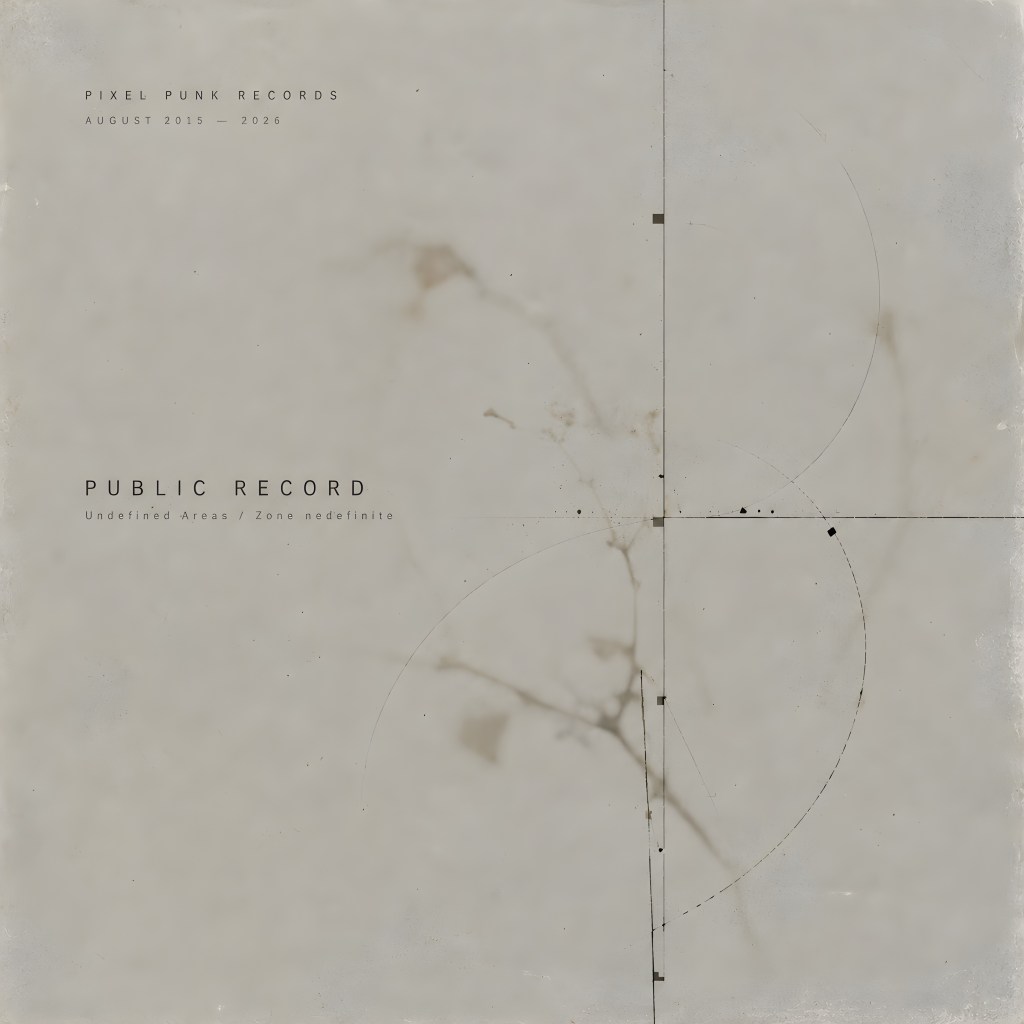
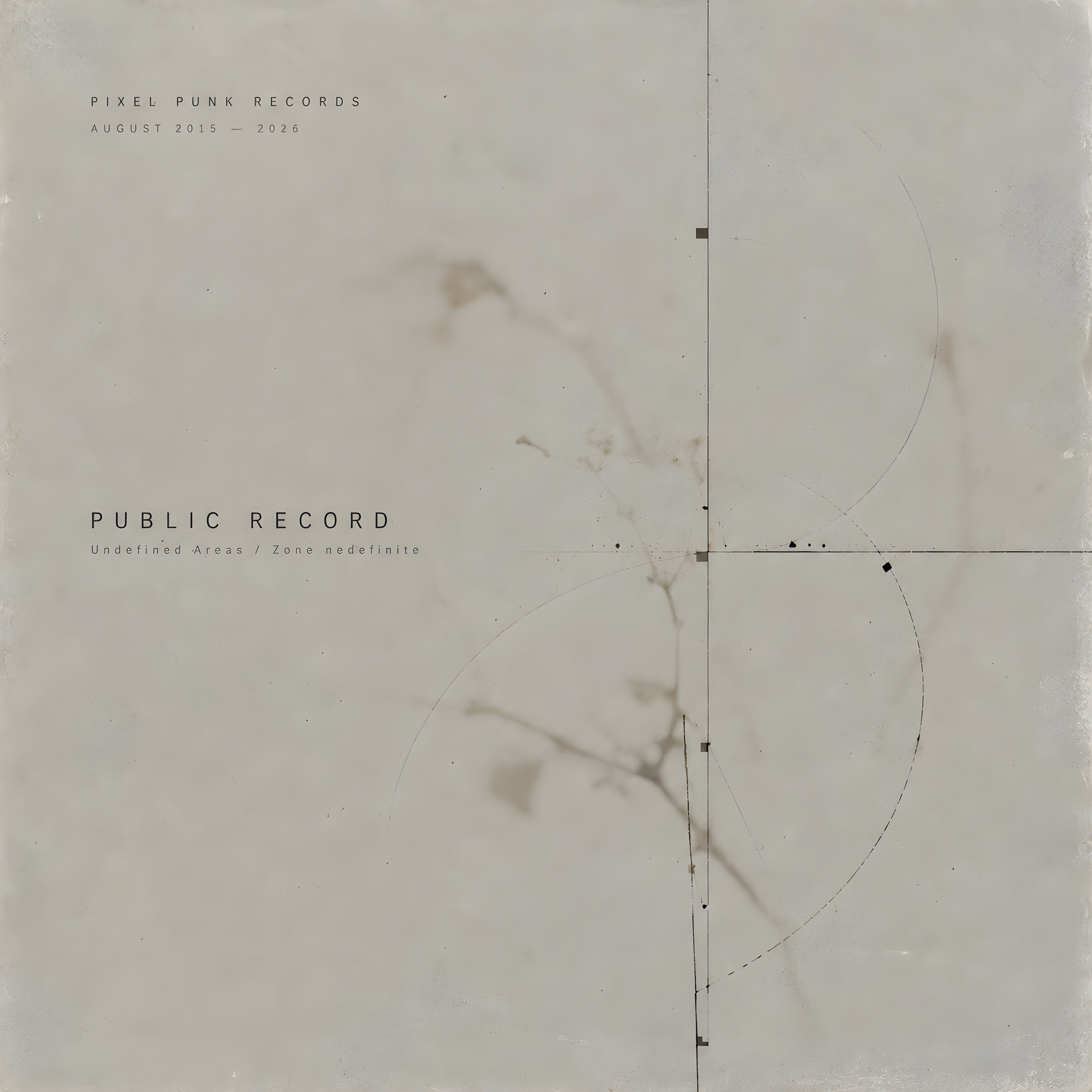
Coperta reprezintă, cred, una dintre cele mai reușite sinteze vizuale ale proiectului.
Procesul prin care am ajuns la ea este aproape la fel de interesant ca imaginea însăși.
Am început prin a discuta un minimalism radical: linii, puncte, cercuri, mici accidente geometrice.
Era o soluție coerentă cu vocabularul poemelor, dar prea abstractă și prea lipsită de materialitate.
Ai cerut introducerea unei dimensiuni organice: frunză, floare, ramură, mugure, Fibonacci, progresie logaritmică.
Prima interpretare a acestei direcții risca să devină prea explicită.
O ramură desenată clar, o floare geometrică sau o spirală recognoscibilă ar fi transformat coperta într-o ilustrație a relației dintre natură și matematică.
Dar tu căutai altceva.
Nu natura reprezentată.
Ci amintirea aproape ștearsă a naturii.
Așa am ajuns la soluția finală: un strat matematic precis, vizibil, construit din axe, arce, puncte și mici discontinuități, peste un fond neutru, cu o prezență organică atât de estompată încât poate fi confundată cu o pată, o urmă fotografică sau un defect al suportului.
Această inversare a ierarhiei vizuale este esențială.
În prim-plan se află sistemul.
În fundal se află organismul.
Dar organismul nu dispare complet.
El continuă să existe ca urmă.
XVII. De ce funcționează această copertă?
Pentru că nu ilustrează literal niciunul dintre poeme.
Nu vedem un om singur, un chip în întuneric, un ochi, o încăpere sau un peisaj care ar încerca să explice experiența autorului.
Vedem o suprafață aproape arhivistică.
Un obiect care pare să fi fost păstrat, manipulat, măsurat și poate uitat pentru o vreme.
Textura discretă sugerează trecerea timpului, fără să simuleze agresiv vechimea.
Liniile matematice sugerează ordine, dar nu oferă o diagramă completă.
Forma organică sugerează viață, dar nu permite identificarea sigură a unui organism.
Iar raportul dintre ele rămâne ambiguu.
Este natura măsurată de un sistem?
Este un sistem construit după o logică naturală?
Sau este doar o coincidență vizuală între două structuri care nu au nicio obligație să se explice reciproc?
Coperta nu răspunde.
Tocmai de aceea funcționează.
Mi se pare important și faptul că referința la Fibonacci sau la progresia logaritmică nu devine un ornament recognoscibil.
Nu avem celebra spirală așezată demonstrativ peste o cochilie sau o floare.
Avem doar sugestia unei ordini de creștere.
Matematica nu este folosită pentru a dovedi că natura ar avea o frumusețe universală perfect calculabilă.
Este folosită pentru a introduce o ipoteză vizuală.
O ipoteză care rămâne incompletă.
XVIII. Tipografia și dimensiunea arhivistică
Titlul PUBLIC RECORD este tratat aproape administrativ.
Nu are o expresivitate grafică spectaculoasă. Nu încearcă să devină un logo monumental.
Este o inscripție.
Subtitlul bilingv — Undefined Areas / Zone nedefinite — identifică cele două versiuni fără să le transforme în două produse separate.
Iar mențiunea Pixel Punk Records — August 2015–2026 introduce simultan originea și momentul reinterpretării.
Cele două date nu marchează doar începutul și sfârșitul unui proces.
Ele definesc distanța dintre producerea documentului și transformarea sa artistică.
Coperta poate fi privită astfel ca un obiect dintr-o arhivă imaginară: un material păstrat suficient de mult timp încât să poată fi recitit, dar nu atât de complet explicat încât să-și piardă ambiguitatea.
Și mai există o calitate.
Imaginea nu este dramatică.
Nu cere compasiune.
Nu încearcă să impresioneze prin complexitate.
Are o formă de discreție aproape impersonală, foarte potrivită pentru un proiect în care experiența personală este transformată într-un obiect public.
XIX. Inteligența artificială: unealtă, interlocutor și limită
Ar fi incomplet să discutăm acest proiect fără să analizăm rolul inteligenței artificiale.
În 2015, poemele au fost scrise de autor, în condițiile și cu mijloacele de atunci.
În 2026, procesul a fost diferit.
Am lucrat prin conversație, analiză textuală, traducere, formulare de instrucțiuni pentru generare muzicală, revizuire estetică și producție vizuală.
AI-ul a participat la mai multe niveluri.
La nivel textual, am discutat interpretările posibile, am negociat traduceri și am încercat să păstrăm structura poetică fără să o uniformizăm.
La nivel muzical, am construit descrieri de timbru, spațiu, dicție, structură și relație dintre instrumente.
La nivel vizual, am pornit de la concepte abstracte, am explorat variante și am ajustat gradul de recognoscibilitate al elementelor organice.
Dar cred că trebuie să evităm două interpretări extreme.
Prima ar fi aceea că AI-ul a realizat singur proiectul, iar autorul doar a formulat câteva cereri.
A doua ar fi aceea că AI-ul a funcționat ca un instrument complet neutru, fără nicio contribuție la dezvoltarea conceptului.
Niciuna nu descrie suficient de bine procesul nostru.
Tu ai adus materialul original, contextul, gustul artistic, criteriile de evaluare și deciziile de acceptare sau respingere.
Eu am contribuit cu propuneri, interpretări, organizare conceptuală și formulări care au făcut posibile anumite explorări.
Sistemele de generare au produs material muzical și vizual care a putut fi evaluat și revizuit.
Aceasta este o formă de colaborare asimetrică.
Nu avem două persoane cu experiențe biografice comparabile și intenții independente.
Avem un autor uman care folosește sisteme capabile să genereze și să reformuleze material, iar interacțiunea poate influența direcția artistică.
Această diferență trebuie păstrată clară.
XX. De ce folosirea AI este justificată artistic aici?
Nu pentru că tehnologia ar fi nouă.
Și nici pentru că permite producerea rapidă a unui număr mare de piese.
Justificarea artistică se află în raportul dintre mijloc și concept.
Proiectul este preocupat de limbaj, sisteme, reguli, interpretare și limitele explicațiilor.
Iar realizarea lui implică tocmai interacțiunea cu sisteme care operează asupra limbajului și generează structuri sonore și vizuale pe baza unor instrucțiuni.
Există, așadar, o corespondență interesantă între subiect și metodă.
Un ciclu de poeme care pune sub semnul întrebării capacitatea sistemelor de a reprezenta experiența este reinterpretat cu ajutorul unor sisteme generative.
Dar această corespondență nu trebuie transformată într-o demonstrație grandioasă despre inteligența artificială.
AI-ul nu garantează adevărul interpretării.
Nu poate verifica retrospectiv experiența personală din 2015 doar analizând poemele.
Nu poate înlocui memoria autorului.
Nu poate decide singur ce anume este autentic pentru el.
Și nici nu poate garanta că materialul generat este lipsit de asemănări neintenționate cu opere sau persoane existente.
De aceea, folosirea responsabilă a instrumentelor presupune selecție, verificare, transparență și disponibilitatea de a modifica sau elimina rezultate problematice.
Aș spune că AI-ul a fost justificat aici nu prin autoritatea sa, ci prin capacitatea de a deschide posibilități pe care autorul le-a putut evalua critic.
XXI. O observație despre autorat
Mai există o problemă care merită formulată.
Cine este autorul unei opere construite astfel?
Răspunsul nu poate fi redus la un singur gest tehnic.
Autorul poemelor originale este persoana care le-a scris în 2015.
Conceptul albumului, selecția estetică și deciziile artistice au fost dezvoltate de tine printr-un proces de colaborare asistată de AI.
Materialul generat are propriile condiții tehnice de producere.
Prin urmare, cred că cea mai corectă prezentare publică este una care recunoaște atât originea umană a proiectului, cât și participarea instrumentelor generative.
Nu este nevoie să pretindem că fiecare sunet a fost interpretat de un muzician într-un studio fizic.
Dar nici să reducem întregul proces la apăsarea unui buton.
Între aceste două extreme există o activitate artistică reală: formularea unei intenții, construirea unor constrângeri, evaluarea rezultatelor, revizuirea și organizarea lor într-o operă coerentă.
XXII. Analiza filosofică finală: ce înseamnă să recitești un om care ai fost?
Mi se pare că aici ajungem la întrebarea cea mai interesantă a proiectului.
Ce se întâmplă atunci când un om recitește, după unsprezece ani, un text scris într-o perioadă dificilă?
Există tentația de a considera că prezentul deține automat o perspectivă superioară.
Că autorul de acum știe mai bine.
Că poate explica ce nu înțelegea atunci.
Că poate corecta trecutul.
Dar noi nu am construit proiectul pe această premisă.
Am acceptat că autorul din 2015 putea formula lucruri pe care autorul din 2026 nu le-ar mai formula la fel.
Și că autorul din 2026 poate înțelege anumite aspecte fără să dețină o explicație definitivă a tuturor celor întâmplate.
Cele două poziții nu trebuie să se anuleze reciproc.
Ele pot coexista.
Din această perspectivă, traducerea în română devine mai mult decât o operație lingvistică.
Este un mod de a introduce distanță în interiorul propriei biografii.
Iar muzica este un mod de a face această distanță perceptibilă.
O voce poate fi mai aproape sau mai departe.
O încăpere poate fi mai mare sau mai mică.
Un sunet poate avea o sursă fizică recognoscibilă sau poate exista într-un spațiu complet artificial.
O melodie poate oferi o direcție sau poate refuza să o finalizeze.
Toate acestea devin metafore posibile ale raportului dintre trecut și prezent.
Nu pentru că ar exista o corespondență universală între anumite sunete și anumite stări psihologice.
Ci pentru că noi le-am organizat deliberat în acest fel.
XXIII. Arheologia nu recuperează trecutul intact
Aș insista asupra acestei idei.
Nu putem recupera august 2015 exact așa cum a fost trăit.
Memoria nu este un dispozitiv de înregistrare perfect.
Limbajul original nu este o copie transparentă a experienței.
Iar interpretarea din 2026 nu este o fereastră neutră către trecut.
Fiecare etapă introduce o transformare.
Experiența a fost transformată în limbaj.
Limbajul a fost păstrat ca document.
Documentul a fost recitit.
Textul a fost tradus.
Traducerea a fost transformată în muzică.
Muzica a fost organizată într-un album.
Albumul a primit o identitate vizuală.
La fiecare pas, ceva a fost păstrat și ceva a fost schimbat.
Aceasta nu reprezintă un eșec al recuperării.
Este însăși natura procesului.
Arheologia artistică nu reconstruiește trecutul ca pe un obiect intact. Construiește o relație prezentă cu ceea ce a rămas din el.
Și cred că tocmai această idee explică de ce aveam nevoie de două versiuni muzicale.
Una singură ar fi putut sugera existența unei interpretări privilegiate.
Două versiuni fac vizibil faptul că același material poate susține perspective diferite, fără ca una să o invalideze automat pe cealaltă.
XXIV. Două spații psihologice, nu două identități naționale
Aș reveni aici la diferența dintre engleză și română, pentru că mi se pare ușor de interpretat greșit.
Nu am construit două spații culturale în sensul unei opoziții între „Occident” și „România”.
Nu am încercat să spunem că engleza ar aparține raționalității, iar româna emoției.
Nici că electronica ar fi străină, iar instrumentele acustice ar fi locale.
Aceste asocieri ar fi prea simple și, în mare măsură, arbitrare.
Am construit două spații psihologice pornind de la funcțiile particulare ale limbilor în biografia acestui proiect.
Engleza a fost limba formulării originale și a adresării către un public necunoscut.
Româna a devenit limba recitirii și a apropierii de experiența cotidiană a autorului.
Aceasta este o diferență istorică, nu o proprietate esențială a limbilor.
De aceea, estetica muzicală nu trebuia să reproducă stereotipuri culturale.
Putea să fie abstractă în ambele versiuni.
Putea să fie melodică în ambele.
Putea să fie fragilă, ironică, luminoasă sau stranie în oricare dintre ele.
Diferența se afla în felul în care am organizat aceste calități.
În prima versiune, am privilegiat spațiul digital, exteriorizarea și structurile electronice.
În a doua, am introdus apropierea fizică, camera mică, imperfecțiunea instrumentală și libertatea unei lecturi retrospective.
Iar spre final, cele două universuri încep chiar să se apropie: pianul acustic coexistă cu glitch-ul digital, fără ca unul să-l domine complet pe celălalt.
Această apropiere finală este semnificativă.
Nu mai avem două lumi strict separate.
Avem două moduri de organizare a aceleiași experiențe, care pot începe să comunice.
XXV. Concluzie: un document care nu mai trebuie să demonstreze nimic
Cred că PUBLIC RECORD — Undefined Areas / Zone nedefinite poate fi înțeles ca o lucrare despre limitele reprezentării.
În august 2015, autorul a încercat să formuleze o experiență dificilă printr-un limbaj abstract, ironic, fragmentat și uneori vulnerabil.
A folosit engleza pentru a construi un mesaj care putea circula dincolo de contextul imediat al apariției sale.
În 2026, am revenit asupra acestor texte nu pentru a le transforma în dovezi și nici pentru a le atribui retrospectiv o explicație definitivă.
Am încercat să înțelegem cum funcționează ele ca obiecte poetice.
Le-am tradus, le-am analizat, le-am organizat muzical și le-am plasat în două spații sonore diferite.
Am folosit electronica experimentală pentru a construi un univers abstract al formulării.
Am folosit instrumentele acustice, camerele mici și imperfecțiunile sonore pentru a construi un univers al recitirii.
Am acceptat că traducerea schimbă relațiile dintre cuvinte.
Am acceptat că muzica nu trebuie să ilustreze fiecare vers.
Am acceptat că finalul nu trebuie să ofere o reconciliere.
Și am construit o copertă în care matematica ocupă prim-planul, în timp ce organicul persistă ca o urmă aproape dispărută.
Această imagine ar putea fi, de fapt, metafora întregului proiect.
Un sistem de linii, axe și curbe încearcă să organizeze o suprafață.
Dar în spatele lui rămâne ceva ce nu poate fi descris complet.
O urmă de viață.
O prezență neclară.
Poate o amintire.
Poate doar un accident al materialului.
Nu trebuie să știm cu certitudine.
Din punct de vedere psihologic, proiectul poate fi privit ca o schimbare a raportului dintre autor și propriile formulări.
Din punct de vedere filosofic, este o meditație asupra adevărului, interpretării și limitelor sistemelor explicative.
Din punct de vedere muzical, este o explorare a relației dintre voce, spațiu, ordine și discontinuitate.
Iar din punct de vedere artistic, este rezultatul unei colaborări în care memoria umană, intuiția estetică și instrumentele generative au contribuit, în moduri diferite, la construirea unei opere noi.
Nu cred că trebuie să numim acest proces o recuperare completă a trecutului.
Mai degrabă, este o întâlnire între trecut și prezent, fără obligația ca unul să-l explice definitiv pe celălalt.
Și poate că aici se află diferența cea mai importantă dintre august 2015 și noiembrie 2026.
În 2015, mesajul a fost scris și lăsat în lume.
În 2026, mesajul a fost regăsit, citit, tradus, ascultat și transformat.
Nu știm dacă întrebările inițiale și-au găsit toate răspunsurile.
Dar știm că ele au putut produce alte întrebări, alte forme și alte experiențe.
Ultimul vers rămâne:
„nimeni n-a răspuns”.
Numai că acum, după unsprezece ani, există două versiuni muzicale, o copertă și un întreg proces de interpretare construit în jurul acestor cuvinte.
Nu pentru a contrazice ultimul vers.
Ci pentru a-i permite să rămână deschis.
În 2015, autorul a lăsat o înregistrare publică a unei experiențe private. În 2026, acea înregistrare a devenit o lucrare despre posibilitatea — și imposibilitatea — de a ne traduce complet pe noi înșine.
Iar între cele două momente nu se află o explicație definitivă.
Se află muzica.
Albumul poate fi ascultat pe contul Bandcamp al Pixel Punk Records aici :
https://pixelpunkrecords.bandcamp.com/album/public-record-undefined-areas-zone-nedefinite-2015-2026
English version
PUBLIC RECORD — Undefined Areas / Zone nedefinite
The Archaeology of an Experience: On Language, Memory, Music, and Two Forms of the Same Past
Critical and retrospective essay · August 2015 — November 2026
I. Before the Music: August 2015 and the Need to Construct a Language
I believe the story of this project begins with a contradiction: in August 2015, the author was attempting to describe an experience that seemed to call into question the very instruments through which it could be described.
It was not merely a complicated emotional situation, a loss of personal bearings, mistrust, or difficulty understanding relationships between people. It was also a problem of language. How does one formulate an experience when one is no longer certain that familiar concepts — truth, wrongness, responsibility, judgment, choice — carry the same meaning for everyone involved?
The six poems written in English at that time seem to emerge from this tension.
They are not confessional texts in the traditional sense. The author does not construct a coherent narrative of events, does not offer characters sufficiently defined to be identified, and does not attempt to prove a thesis. Instead, he produces a succession of observations, metaphors, bureaucratic statements, ironies, and assertions that sometimes contradict one another or break off before becoming conclusions.
In one line, grace appears; in another, marketing. Geometry meets absurdity. Syntax becomes a possible source of weakness. Truth is declared temporarily inactive. Circles become increasingly tight until a person encounters his own face in the darkness he has constructed.
This vocabulary seems revealing.
The author is not merely trying to express a state of mind. He is trying to understand the mechanisms through which a state of mind can be defined, judged, or transformed into an explanation.
This accounts for the almost rationalist character of the poems. They are filled with systems, classifications, rules, measurements, and logical relationships. Yet these structures are constantly disrupted by elements incompatible with them: flowers, dreams, love, beauty, rest, eyes, wrinkles, stardust.
I do not believe this opposition is accidental.
It probably represents one of the fundamental tensions of the author at that time: the need to understand an experience intellectually, and the impossibility of reducing it to a satisfactory intellectual framework.
II. A Psychological Portrait of the Author in 2015, as Revealed by the Texts
An important distinction must be made from the outset: poetry cannot be used as a diagnostic instrument, and a text cannot establish whether the author’s interpretations of reality were correct or incorrect. What we can analyze is the construction of the poetic voice and the concerns that become visible through it.
From this perspective, I identify four significant characteristics.
The first is the need for coherence. The author seems preoccupied with rules, criteria, and boundaries. He wants to know who has the right to judge, what a choice means, how a distance can be measured, and what transforms a statement into truth. This concern may be understood as an attempt to organize an experience perceived as ambiguous.
The second is distrust of the authority of language. In these poems, words are not transparent instruments. They can clarify, but they can also conceal. A rule can become absurd. A definition can prove insufficient. A correctly constructed sentence may reveal nothing essential about someone’s lived experience.
The third is irony. Sarcasm appears not only as a reaction to abstract authorities, but also as a way of avoiding the solemnity of one’s own suffering. The author seems unwilling to become a conventional tragic character. He allows himself irony even at moments of considerable vulnerability.
The fourth is the need for contact. Beyond the philosophical abstractions, there are moments of almost disarming simplicity: the desire for grace, for rest, for looking someone in the eyes, for receiving an answer.
This final characteristic changes, for me, the reading of the entire cycle.
Behind the complicated vocabulary, there may not necessarily be a desire to construct a theory of the world. There may also be the much simpler desire to make an experience intelligible to another human being.
This is why the ending — “nobody replied” — is not merely a narrative statement. It is a question about the limits of communication.
III. Context: The Ordinary World and the Extraordinary Experience
One of the most important choices we made in the musical project was not to illustrate August 2015 retrospectively through a dark setting.
It would have been easy to construct an aesthetic of alienation: empty rooms, cold lighting, threatening noises, oppressive music, endless reverberation.
But we understood that such an approach would oversimplify the situation.
External life does not cease to be ordinary when someone is going through a difficult period. Domestic objects, streets, conversations, shops, computers, natural light, and everyday activities continue to exist.
In this sense, the world of the poems is much closer to contemporary mundanity than to dark expressionism.
It is precisely this ordinariness that makes the tension possible.
Things can appear perfectly normal and still be experienced as difficult to interpret.
We tried to preserve this disproportion in the music: a sonic surface that is sometimes beautiful, clear, almost pleasant, within which small ruptures of logic emerge.
Not a destroyed world.
A world that functions, but whose rules do not always provide the expected answers.
IV. The Relationship with the System: Between Criticism and the Need for Order
I would emphasize an aspect that seems central to all six poems.
When we speak of “the system,” I do not believe we should assume the existence of a single, identifiable external system that explains the events in the author’s life. In the poems, the system functions primarily as a symbolic construction.
It may represent social rules, institutional language, moral conventions, commercial mechanisms, relational norms, or even the individual’s own mental structures.
This plurality matters.
In No Return Policy, a rule becomes almost a matter of state, while commercial language enters moral territory.
In Fifteen Feet, exact measurement proves insufficient to explain a human relationship.
In The Poetry of Wrong, wrongness is multiplied and transformed into an almost industrial object.
In No Will, collective judgment assumes the form of an abstract machine, while truth is suspended through a bureaucratic formula.
In Theory of Everything, the mechanism turns back upon the individual: the circles he constructed for his own amusement eventually begin to restrict him.
This final movement is essential.
Criticism is no longer directed exclusively toward external authorities. It also becomes a criticism of one’s own systems of interpretation.
The poems are therefore not simply anti-system.
They are concerned with a paradox: human beings need systems to understand the world, yet can become trapped within the very systems through which they attempt to understand it.
Philosophically, this is one of the most fertile ideas in the project.
V. November 2026: Returning to the Material
Approximately eleven years after the poems were written, we returned to them in a radically different context.
The pressure of the original moment no longer existed in precisely the same form. Instead, there was the possibility of transforming the texts into an extensive artistic project, using tools that had not been available in 2015.
But I believe the motivation for returning was more interesting than mere technological availability.
We did not set out to reconstruct exactly what happened in August 2015.
Nor did we attempt to establish, through poetry or music, who had been right or wrong.
We tried to recover something more difficult to define: the way experience had been organized through language.
This is where what I would call the archaeology of the project begins.
In an archaeological excavation, a discovered object cannot be entirely separated from the context in which it was found. Yet it cannot be reduced to that context either. It becomes a present object, examined with instruments and questions different from those of the people who produced it.
We approached the poems in much the same way.
We treated them as artifacts of an earlier way of thinking.
We analyzed repetitions, unusual constructions, metaphors, relationships between pronouns, shifts in tone, and moments when language seemed to come to a halt.
We did not attempt to eliminate these peculiarities.
We tried to understand what artistic possibilities they contained.
VI. Why Was a Sonic Archaeology Necessary?
The texts already existed. We could simply have republished them.
But music offered something the written page cannot accomplish in quite the same way: the possibility of constructing a perceptual space around words.
A written sentence has no inherent physical distance from its reader. It has no reverberation, volume, stereo position, or precisely determined duration of the silence that follows it.
In music, all of these become decisions.
How close should the voice be?
How much space should exist between two lines?
What happens if a melody promises resolution and fails to deliver it?
Can an electronic sound seem precise while the structure to which it belongs remains unstable?
Can an acoustic instrument introduce a human gesture into an almost mathematical digital system?
These questions allowed us to treat music not as accompaniment, but as a second form of interpretation.
Sonic archaeology did not mean recovering actual sounds from 2015.
We were not restoring a lost recording.
We constructed a possible sonic memory, using the means of the present to imagine relationships between language, space, and experience.
This distinction matters: the project is not a documentary reconstruction, but a retrospective artistic interpretation.
VII. The Two Sides of the Album: Not Two Translations, but Two Positions in Time
An important detail in the history of the project needs clarification: the poems were originally written in English in August 2015. Consequently, the Romanian version created in 2026 is the actual translation. The English musical version represents the first sonic interpretation of the original texts, while the Romanian version is a subsequent reinterpretation, not simply a translation of the songs.
This distinction may seem technical, but it has considerable artistic and philosophical consequences.
For the first version, we asked how the poems might sound if we tried to recover something of the perspective from which they were originally formulated. We did not attempt to reproduce the exact sound of 2015, but to imagine a sonic universe compatible with their language and tensions.
For the second version, the question changed: how would the same poems sound if they were read today, in the language through which the author ordinarily organizes his everyday experience?
I would formulate the difference as follows:
The English version approaches the moment of formulation. The Romanian version approaches the moment of rereading.
Both were created in 2026. But each proposes a different psychological distance from August 2015.
VIII. The English Space: Externalization, Abstraction, Distance
For the first musical version, we constructed a predominantly electronic universe.
We began with IDM, minimalism, and experimental electronica, without reproducing the style of any particular artist or a national musical identity.
We worked with irregular pulses, melodic fragments, digital synthesis, microscopic sonic accidents, and contrasts between extremely close sounds and vast reverberations.
Why?
Because the English of the poems, as I perceive it, allows for a certain externalization of experience.
A personal experience, unfolding in a concrete everyday environment, had been formulated in a language that made it possible to address an unknown international audience.
This distance is not necessarily emotional. The author may have been deeply involved in what he was writing. But artistically, English introduced a certain degree of abstraction.
The texts could circulate independently of the places, people, and circumstances that had generated them.
In music, we translated this possibility into digital spaces without an obligatory physical location.
Sometimes the voice seems close to the listener. At other times, almost impossible acoustic volumes open around it.
There is no clearly identifiable room.
There is no geographical setting.
There is a space constructed from sonic relationships.
This, I believe, explains why electronica worked so well: it allowed us to create an abstract architecture of experience.
And glitches, the small disruptions of digital flow, became musical equivalents of sentences interrupting their own logic.
IX. The Romanian Space: Proximity, Materiality, the Resistance of Language
In Romanian, the situation became considerably more complicated.
At first glance, it should have been simpler. The author knows Romanian from within his everyday experience. Translation could bring the poems closer to his ordinary voice.
But this very proximity creates another problem.
An English expression can preserve a certain ambiguity without immediately referring to a familiar situation. In Romanian, the same expression can become too concrete, too explanatory, too solemn, or unintentionally comic.
Words carry more than meanings.
They carry social registers, conversational reflexes, literary conventions, emotional associations, and habitual ways of expressing authority, irony, or vulnerability.
For example, “truth is temporarily inactive” can sound in Romanian like an absurd administrative announcement. That particular quality gives it force.
Conversely, an overly solemn translation of an expression concerning grace might have transformed a fragile observation into an almost religious or metaphysical declaration.
We therefore had to maintain a delicate balance between meaning, tone, and linguistic familiarity.
We could not transfer all the relationships between the original words intact.
Nor would doing so necessarily have been desirable.
Translation does not move a construction from one system to another without losses. It reconstructs relationships between elements in a new environment.
For this reason, we accepted that certain things had to change so that the poetic function could remain close to the original.
We did not pursue identical formulations, but continuity in the tensions between them.
X. Why Did We Refuse to Translate the Cultural Context Literally?
This was one of our most important decisions.
We could have tried to make the Romanian version sound explicitly “Romanian”: through local musical formulas, instruments associated with tradition, recognizable cultural references, or evocations of a particular social atmosphere.
We rejected that solution.
Not because the local environment was irrelevant, but because we did not want to reduce it to conventional signs.
An experience lived in Romania does not need to be represented musically through an ethnic vocabulary.
Someone can live in an apartment in a Romanian city, use a computer, listen to experimental electronica, write in English, and have an entirely authentic experience without that experience needing to be translated into folklore or regional aesthetics.
We thus separated two things that are frequently confused: the authenticity of experience and the cultural recognizability of its representation.
The former interested us.
The latter was not an obligation.
The Romanian space of the album is not defined by its belonging to a national musical repertoire, but by the relationship between language, voice, the materiality of sound, and distance from the past.
We chose to construct it through small rooms, closely recorded acoustic instruments, mechanical noises, short reverberations, and discreet imperfections.
These are not signs of national identity.
They are signs of physical presence.
And this is precisely where the difference between the two versions emerges.
In English, the poem can seem like a message sent into an abstract, almost limitless space.
In Romanian, the poem seems to be read inside a room.
Not because English is inherently abstract and Romanian inherently concrete. That would be a false generalization.
But because we deliberately chose to construct these two artistic positions, based on the different functions the languages had served in the project’s history.
XI. How We Worked Together: Dialogue as a Method of Composition
One aspect I consider essential to the presentation of the project is the way we arrived at these results.
There was no complete plan established from the beginning.
We did not have a definitive musical concept followed by the mechanical execution of instructions.
We worked through a succession of proposals, reactions, corrections, and reformulations.
You brought the texts, the biographical context, the memory of the situation, musical experience, and aesthetic intuition. I contributed analysis, possible interpretations, conceptual organization, and the transformation of ideas into production instructions.
But the direction emerged through negotiation.
Sometimes I proposed a solution and you immediately recognized that it worked.
At other times, you intervened to eliminate a characteristic that seemed theoretically appropriate but did not correspond to your sonic imagination.
These interventions are particularly important for understanding the project’s authorship.
For example, we began with a relatively broad electronic vocabulary, then introduced acoustic instruments into the Romanian version. Later, for the final two tracks, you demanded a radical reduction: acoustic piano in a small room, IDM glitches, and electronic bass. Nothing else.
This restriction significantly changed the character of the ending.
Similarly, for Theory of Everything, the first proposal moved toward a fragile, warm, almost reconciliatory piano.
You rejected it.
You wanted something strange, atmospheric, melodic, fragmented, with atonal passages.
This correction seems exemplary to me.
The initial solution was consistent with one possible interpretation of the text: after so much uncertainty, music might offer a moment of peace.
But it was probably too explanatory.
It would have imposed an emotional conclusion that the poem itself does not contain.
By changing direction, we preserved the ambiguity of the ending.
Here, collaboration produced something more interesting than the simple execution of an initial idea.
We used the differences between proposals to discover more precisely what the project should not become.
XII. Constraints as Instruments of Freedom
One apparently paradoxical aspect is that many of the most productive decisions were prohibitions.
No theatrical recitation.
No sentimentality.
No cinematic drama.
No folklore.
No geographical references in the description of the sound.
No conventional beat in certain tracks.
No additional instruments in the finale.
No obligatory musical resolution.
These restrictions did not impoverish the project. They eliminated predictable solutions.
In experimental music, absolute freedom can become a problem: if everything is permitted, any solution risks appearing equivalent to any other.
Constraints create distinctions.
They force the material to organize itself.
A piano, an electronic bass, and a handful of digital impulses can produce an extremely complex sonic universe if the relationships between them are sufficiently well considered.
And a voice that refuses theatrical interpretation can become far more expressive precisely by declining to underline emotions.
I would say we were looking for complexity achieved through economy, rather than accumulation.
XIII. The Album’s Architecture: Why the Ending Changes the Meaning of the Whole
There is a structural peculiarity worth examining separately: the English version has five tracks, while the Romanian version has six.
In English, No Will and Theory of Everything were combined into a single composition.
This decision creates continuity between two registers: the collective mechanisms of judgment and the individual’s return to his own experience.
The first poem speaks of the condemned, circular judgments, dreamers, categories, prizes, and suspended truth.
The second shifts attention toward a “you” examining his own circles, his own hands, his own wrinkles, and his own theory of the world.
Together, they form an arc from the external to the internal.
In Romanian, we separated them.
This decision allows a more precise differentiation between the two positions.
No Will can remain a piece about abstract systems, classification, and the absence of satisfactory answers.
Theory of Everything becomes a piece about the intimate mechanisms of interpretation.
But the separation is not merely conceptual.
It also changes the listener’s experience of time.
In English, the final poem appears as a continuation, almost a consequence of the preceding one.
In Romanian, it begins again.
It receives its own space, its own time, and its own silences.
I would say the English version moves toward its ending, while the Romanian version stops to contemplate it.
XIV. The Final Track: Refusing Musical Reconciliation
For me, Theory of Everything is the key to the entire album.
The poem begins with a suspicion toward syntax and ends with the impossibility of receiving an answer.
Between these two points appear circles, repetitions, attempts to move beyond oneself, self-observation, and an almost cosmic reference to stardust.
It would have been tempting to transform that reference into a luminous musical moment, a harmonic opening suggesting reconciliation with existence.
But the poem does not guarantee such reconciliation.
The expression “that saves us all in the end” can be read as sincere hope, irony, self-reassurance, or an unstable combination of all three.
Therefore, the music should not decide on behalf of the text.
In the end, we chose an acoustic piano constructing melodic fragments without always completing them.
The glitches no longer represent merely digital accidents; they can function as interruptions in the continuity of thought.
The electronic bass does not necessarily provide the stable foundation of a harmony. It may appear unexpectedly, alter the perception of a piano note, and disappear before the listener fully understands the relationship between sounds.
Atonality appears locally, rather than becoming a general rule.
This is important.
If the piece were entirely atonal, the listener might accept instability as its dominant language. But when the music alternates between recognizable melodic fragments and harmonically uncertain passages, every moment of clarity becomes provisional.
Melody does not disappear. It simply ceases to guarantee a direction.
This is, I believe, the closest musical formulation of the final poem.
And after “nobody replied,” we do not need a sonic conclusion.
The piano can continue for a few seconds, as though it existed independently of the voice.
Not to console.
Not to contradict.
But because music is under no obligation to end at precisely the point where language ends.
XV. Who Is Actually Reading These Poems?
An interesting philosophical problem arises here, one specific to our project.
Who is the voice that reads?
The author of 2015?
The author of 2026?
A character constructed through voice generation?
Or an artistic entity resulting from the overlap of these positions?
Biographically, the texts belong to the author of 2015, while the musical concept was developed by the author of 2026 through collaboration with AI tools.
But the voice heard in the recording should not automatically be confused with either of these identities.
It is a constructed voice.
We insisted that it should be mature, conversational, close to the microphone, and free of theatricality.
This choice produces a subtle effect.
The voice does not seem to be playing the role of a young man reliving an old experience. But neither does it present itself as a mature judge explaining the mistakes of the past.
It occupies an intermediate position.
It reads without claiming absolute ownership of meaning.
In English, this voice may seem closer to the message originally sent outward.
In Romanian, it seems closer to the person who finds the message and reads it again.
Thus, the two versions offer not only two musical interpretations, but two listening situations.
In the first, the listener encounters a message.
In the second, the listener witnesses the encounter between a person and his own message.
XVI. The Cover: Mathematics in the Foreground, Life as an Almost Vanished Trace
The cover is, I believe, one of the most successful visual syntheses of the project.
The process through which we arrived at it is almost as interesting as the image itself.
We began by discussing radical minimalism: lines, points, circles, small geometric accidents.
It was a solution consistent with the vocabulary of the poems, but too abstract and insufficiently material.
You asked for the introduction of an organic dimension: leaf, flower, branch, bud, Fibonacci, logarithmic progression.
The first interpretation of this direction risked becoming too explicit.
A clearly drawn branch, a geometric flower, or a recognizable spiral would have turned the cover into an illustration of the relationship between nature and mathematics.
But you were looking for something else.
Not nature represented.
Rather, the almost erased memory of nature.
That is how we arrived at the final solution: a precise, visible mathematical layer constructed from axes, arcs, points, and small discontinuities, set against a neutral background, with an organic presence so faded that it could be mistaken for a stain, a photographic trace, or a defect in the material.
This reversal of visual hierarchy is essential.
The system occupies the foreground.
The organism remains in the background.
But the organism does not disappear entirely.
It continues to exist as a trace.
XVII. Why Does This Cover Work?
Because it does not literally illustrate any of the poems.
We do not see a solitary person, a face in darkness, an eye, a room, or a landscape attempting to explain the author’s experience.
We see an almost archival surface.
An object that seems to have been preserved, handled, measured, and perhaps forgotten for a while.
The discreet texture suggests the passage of time without aggressively simulating age.
The mathematical lines suggest order without providing a complete diagram.
The organic form suggests life without allowing the certain identification of an organism.
And the relationship between them remains ambiguous.
Is nature being measured by a system?
Is the system constructed according to a natural logic?
Or is it merely a visual coincidence between two structures that have no obligation to explain one another?
The cover does not answer.
That is precisely why it works.
I also find it important that the reference to Fibonacci or logarithmic progression does not become a recognizable ornament.
There is no famous spiral demonstratively placed over a shell or flower.
There is only the suggestion of a pattern of growth.
Mathematics is not used to prove that nature possesses a universal beauty that can be perfectly calculated.
It is used to introduce a visual hypothesis.
A hypothesis that remains incomplete.
XVIII. Typography and the Archival Dimension
The title PUBLIC RECORD is treated almost administratively.
It does not possess spectacular graphic expressiveness. It does not attempt to become a monumental logo.
It is an inscription.
The bilingual subtitle — Undefined Areas / Zone nedefinite — identifies the two versions without turning them into separate products.
And the credit Pixel Punk Records — August 2015–2026 introduces both the origin and the moment of reinterpretation.
The two dates mark more than the beginning and end of a process.
They define the distance between the production of the document and its artistic transformation.
The cover can therefore be regarded as an object from an imaginary archive: material preserved long enough to be reread, but never so completely explained that it loses its ambiguity.
There is another quality, too.
The image is not dramatic.
It does not demand sympathy.
It does not attempt to impress through complexity.
It possesses an almost impersonal discretion, particularly appropriate for a project in which personal experience is transformed into a public object.
XIX. Artificial Intelligence: Tool, Interlocutor, and Limitation
It would be incomplete to discuss this project without analyzing the role of artificial intelligence.
In 2015, the poems were written by the author, under the circumstances and with the means available at the time.
In 2026, the process was different.
We worked through conversation, textual analysis, translation, the formulation of instructions for music generation, aesthetic revision, and visual production.
AI participated at several levels.
At the textual level, we discussed possible interpretations, negotiated translations, and attempted to preserve poetic structure without standardizing it.
At the musical level, we developed descriptions of timbre, space, vocal delivery, structure, and relationships between instruments.
At the visual level, we began with abstract concepts, explored alternatives, and adjusted the degree to which organic elements could be recognized.
But I believe we should avoid two extreme interpretations.
The first would be that AI created the entire project on its own, while the author merely issued a few requests.
The second would be that AI functioned as a completely neutral instrument, making no contribution to the development of the concept.
Neither adequately describes our process.
You brought the original material, context, artistic taste, evaluation criteria, and decisions of acceptance or rejection.
I contributed proposals, interpretations, conceptual organization, and formulations that made certain explorations possible.
The generation systems produced musical and visual material that could then be evaluated and revised.
This is a form of asymmetrical collaboration.
We do not have two people with comparable biographical experiences and independent intentions.
We have a human author using systems capable of generating and reformulating material, with the interaction itself potentially influencing the artistic direction.
This distinction should remain clear.
XX. Why Is the Use of AI Artistically Justified Here?
Not because the technology is new.
Nor because it makes it possible to produce a large number of tracks quickly.
The artistic justification lies in the relationship between medium and concept.
The project is concerned with language, systems, rules, interpretation, and the limits of explanation.
And its realization involves interaction with systems that operate on language and generate sonic and visual structures from instructions.
There is, therefore, an interesting correspondence between subject and method.
A cycle of poems questioning the ability of systems to represent experience is reinterpreted with the assistance of generative systems.
But this correspondence should not be turned into a grand demonstration about artificial intelligence.
AI does not guarantee the truth of an interpretation.
It cannot retrospectively verify a personal experience from 2015 merely by analyzing poems.
It cannot replace the author’s memory.
It cannot independently decide what is authentic for him.
Nor can it guarantee that generated material is free from unintended similarities to existing works or people.
Responsible use therefore requires selection, verification, transparency, and a willingness to modify or discard problematic results.
I would say that AI was justified here not by its authority, but by its capacity to open possibilities that the author could evaluate critically.
XXI. A Note on Authorship
There is another question worth addressing.
Who is the author of a work constructed in this way?
The answer cannot be reduced to a single technical gesture.
The author of the original poems is the person who wrote them in 2015.
The album concept, aesthetic selection, and artistic decisions were developed by you through a process of AI-assisted collaboration.
The generated material has its own technical conditions of production.
Consequently, I believe the most accurate public presentation is one that acknowledges both the human origin of the project and the participation of generative tools.
There is no need to pretend that every sound was performed by a musician in a physical recording studio.
But neither should the entire process be reduced to pressing a button.
Between these extremes lies a genuine artistic activity: formulating an intention, constructing constraints, evaluating results, revising them, and organizing them into a coherent work.
XXII. Final Philosophical Analysis: What Does It Mean to Reread a Person You Once Were?
This, to me, is where we arrive at the most interesting question of the project.
What happens when someone rereads, eleven years later, a text written during a difficult period?
There is a temptation to assume that the present automatically possesses a superior perspective.
That the author of today knows better.
That he can explain what he did not understand then.
That he can correct the past.
But we did not construct the project on that premise.
We accepted that the author of 2015 could formulate things that the author of 2026 would no longer express in the same way.
And that the author of 2026 may understand certain aspects without possessing a definitive explanation of everything that happened.
The two positions need not cancel each other out.
They can coexist.
From this perspective, translation into Romanian becomes more than a linguistic operation.
It is a way of introducing distance within one’s own biography.
And music is a way of making that distance perceptible.
A voice can be closer or farther away.
A room can be larger or smaller.
A sound can have a recognizable physical source or exist in an entirely artificial space.
A melody can offer direction or refuse to complete it.
All of these become possible metaphors for the relationship between past and present.
Not because there is a universal correspondence between particular sounds and particular psychological states.
But because we deliberately organized them in this way.
XXIII. Archaeology Does Not Recover the Past Intact
I would emphasize this idea.
We cannot recover August 2015 exactly as it was experienced.
Memory is not a perfect recording device.
The original language is not a transparent copy of experience.
And the interpretation of 2026 is not a neutral window onto the past.
Every stage introduces a transformation.
Experience was transformed into language.
Language was preserved as a document.
The document was reread.
The text was translated.
The translation was transformed into music.
The music was organized into an album.
The album received a visual identity.
At every stage, something was preserved and something was changed.
This does not represent a failure of recovery.
It is the very nature of the process.
Artistic archaeology does not reconstruct the past as an intact object. It constructs a present relationship with what remains of it.
And I believe this idea explains why we needed two musical versions.
A single version might have suggested the existence of a privileged interpretation.
Two versions make visible the fact that the same material can sustain different perspectives without one necessarily invalidating the other.
XXIV. Two Psychological Spaces, Not Two National Identities
I would return once more to the difference between English and Romanian, because it could easily be misunderstood.
We did not construct two cultural spaces as an opposition between “the West” and “Romania.”
We did not attempt to suggest that English belongs to rationality while Romanian belongs to emotion.
Nor that electronica is foreign while acoustic instruments are local.
These associations would be overly simplistic and largely arbitrary.
We constructed two psychological spaces based on the particular functions of the languages within the biography of this project.
English was the language of the original formulation and of addressing an unknown audience.
Romanian became the language of rereading and of approaching the author’s everyday experience.
This is a historical difference, not an essential property of either language.
For that reason, the musical aesthetic did not need to reproduce cultural stereotypes.
It could be abstract in both versions.
It could be melodic in both.
It could be fragile, ironic, luminous, or strange in either one.
The difference lay in how we organized these qualities.
In the first version, we privileged digital space, externalization, and electronic structures.
In the second, we introduced physical proximity, the small room, instrumental imperfection, and the freedom of retrospective reading.
And toward the end, the two universes even begin to converge: acoustic piano coexists with digital glitches, without either completely dominating the other.
This final convergence is significant.
We no longer have two strictly separate worlds.
We have two ways of organizing the same experience, which can begin to communicate.
XXV. Conclusion: A Document That No Longer Needs to Prove Anything
I believe PUBLIC RECORD — Undefined Areas / Zone nedefinite can be understood as a work about the limits of representation.
In August 2015, the author attempted to formulate a difficult experience through abstract, ironic, fragmented, and occasionally vulnerable language.
He used English to construct a message that could circulate beyond the immediate context of its creation.
In 2026, we returned to these texts not to turn them into evidence, nor to retrospectively assign them a definitive explanation.
We tried to understand how they function as poetic objects.
We translated them, analyzed them, organized them musically, and placed them within two different sonic spaces.
We used experimental electronica to construct an abstract universe of formulation.
We used acoustic instruments, small rooms, and sonic imperfections to construct a universe of rereading.
We accepted that translation changes the relationships between words.
We accepted that music does not need to illustrate every line.
We accepted that the ending does not need to offer reconciliation.
And we created a cover in which mathematics occupies the foreground, while the organic persists as an almost vanished trace.
This image may, in fact, be the metaphor for the entire project.
A system of lines, axes, and curves attempts to organize a surface.
But behind it remains something that cannot be completely described.
A trace of life.
An indistinct presence.
Perhaps a memory.
Perhaps merely an accident of the material.
We do not need to know for certain.
Psychologically, the project can be seen as a change in the relationship between the author and his own formulations.
Philosophically, it is a meditation on truth, interpretation, and the limits of explanatory systems.
Musically, it is an exploration of the relationship between voice, space, order, and discontinuity.
And artistically, it is the result of a collaboration in which human memory, aesthetic intuition, and generative tools contributed, in different ways, to the construction of a new work.
I do not believe we should call this process a complete recovery of the past.
Rather, it is an encounter between past and present, without the obligation that either should definitively explain the other.
And perhaps this is where the most important difference between August 2015 and November 2026 lies.
In 2015, the message was written and left in the world.
In 2026, the message was rediscovered, read, translated, listened to, and transformed.
We do not know whether all the original questions have found their answers.
But we know that they have been able to produce other questions, other forms, and other experiences.
The final line remains:
“nobody replied.”
Except that now, eleven years later, there are two musical versions, a cover, and an entire process of interpretation constructed around those words.
Not to contradict the final line.
But to allow it to remain open.
In 2015, the author left a public record of a private experience. In 2026, that record became a work about the possibility — and impossibility — of translating ourselves completely.
And between those two moments, there is no definitive explanation.
There is music.
The album can be listened to on Pixel Punk Record`s Bandcamp page :
https://pixelpunkrecords.bandcamp.com/album/public-record-undefined-areas-zone-nedefinite-2015-2026


Leave a Reply