
Română
Seria de lucrări poate fi privită ca o explorare a subiectului prins într-o lume în care realitatea nu mai este accesibilă în mod direct, ci este permanent mediată de semne, coduri, roluri și mecanisme de reprezentare. În aceste imagini, absurdul nu apare doar ca o deformare suprarealistă a cotidianului, ci ca efect al unei situații în care subiectul încearcă să se orienteze într-un sistem ale cărui reguli sunt simultan vizibile și imposibil de fixat. Personajele nu sunt pur și simplu plasate în situații absurde; ele par capturate în interiorul unor scheme pe care nu le controlează și al căror sens se modifică permanent.
Una dintre caracteristicile centrale ale seriei este ambiguitatea semnului. În prima lucrare, figura centrală ține o carte de joc, iar deasupra ei apar două entități feminine care își schimbă poziția și, odată cu rotația cărții, își schimbă și relația semantică. Imaginea nu are un singur sens stabil, ci funcționează ca un obiect reversibil. În același timp, figura paternală care ar putea sugera autoritatea, ordinea sau instituția este transformată într-un cub Rubik, devenind ea însăși un obiect de joc, configurabil și reconfigurabil. Autoritatea nu mai fixează sensul, ci devine parte din mecanismul prin care sensul este schimbat. Personajul central este astfel prins între reprezentări care se pot întoarce pe dos, între simboluri care nu încetează să-și schimbe poziția și semnificația.
Această instabilitate a semnului este dusă mai departe în lucrarea construită în jurul automobilului. Textul aparent cifrat nu este rezultatul unui cod prestabilit, ci al unui gest spontan: litere apăsate rapid și aleatoriu pe tastatură. Din acest zgomot grafic se naște însă impresia unui mesaj ascuns. Privitorul este aproape inevitabil tentat să caute o logică, să descifreze, să presupună că în spatele succesiunii de caractere există o informație inaccesibilă. Lucrarea devine astfel o demonstrație a felului în care sensul poate fi proiectat asupra unui material lipsit inițial de intenție semantică. Zgomotul capătă aparența codului. Într-o cultură saturată de informație, tehnologie, publicitate și discursuri specializate, această transformare a aleatoriului în mesaj devine o metaforă pentru mecanismele prin care suntem determinați să presupunem că orice semn trebuie să însemne ceva.
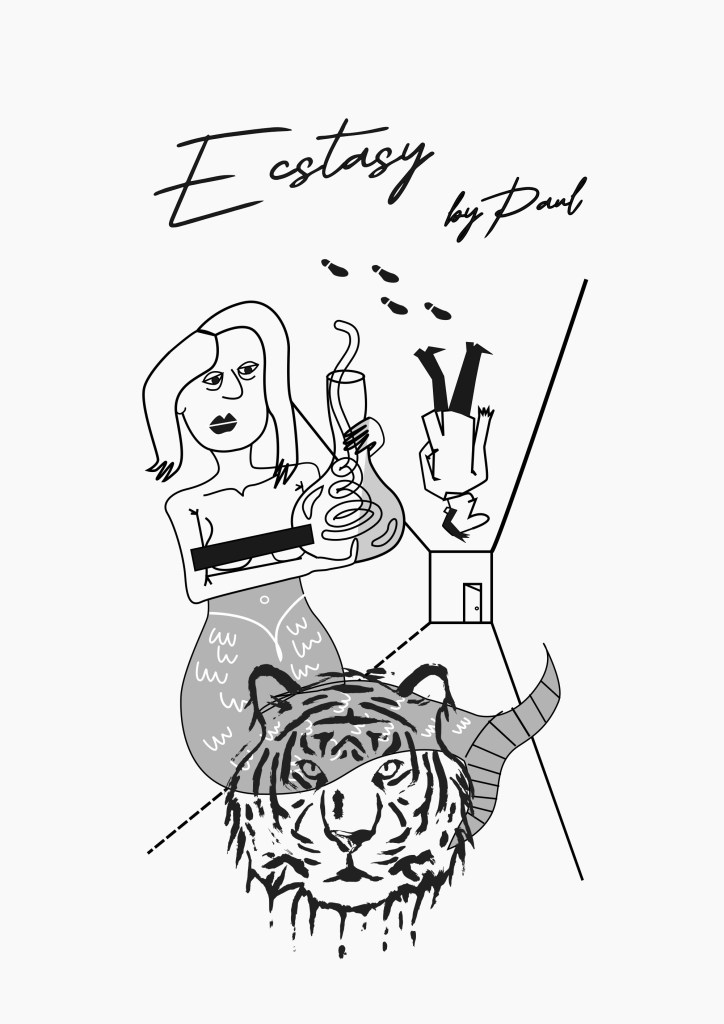
În lucrarea „Ecstasy”, absurdul se transformă într-o scenă aproape teatrală. O femeie, cu o prezență care poate fi citită ca aceea a unei sirene, expune publicului un șarpe în interiorul unui recipient, ca într-un spectacol sau într-o demonstrație. În contrapunct, figura masculină pare să meargă pe tavan, îndreptându-se către o ieșire. Situația este construită în jurul unei inversări a normalității: unul dintre personaje participă la spectacol, celălalt încearcă să evadeze din el, iar însăși gravitația pare să se fi modificat. Seducția, spectacolul, instinctul și tentativa de ieșire coexistă într-un spațiu în care nu mai este clar dacă personajele sunt actori, spectatori sau prizonieri ai situației. Absurditatea devine astfel o experiență a captivității într-un scenariu pe care cineva pare să-l fi construit înaintea lor.
O altă lucrare prezintă un personaj abia ieșit dintr-un ou, într-o imagine care poate fi citită ca o alegorie a nașterii subiectului în interiorul sistemului. Copilul nu apare într-un spațiu gol, în care ar avea posibilitatea de a-și construi liber identitatea, ci este imediat echipat cu obiecte și semnale prin care trebuie să învețe să opereze în lumea care îl așteaptă. Steagurile pe care le ține în mâini sugerează un alfabet al comportamentului: înainte de a-și putea construi propriul limbaj, individul primește deja instrumentele prin care trebuie să comunice, să semnalizeze și să se poziționeze. Chiar și spațiul de sub picioarele sale este invadat de simboluri. Sistemul nu se află doar în jurul subiectului, ci este înscris în mediul în care acesta învață să existe.
În imaginea mâinii ieșite din mormânt, această relație dintre individ și sistem capătă o dimensiune organică și morbidă. Mâna, rămasă după dispariția corpului, ține semințe, în timp ce păpădii, insecte și elemente vegetale plutesc în jurul ei. Moartea nu reprezintă aici o întrerupere definitivă, ci o altă formă de circulație. Semințele, plantele și insectele sugerează propagarea, transmiterea și transformarea materiei. Subiectul dispărut continuă să participe, într-o formă reziduală, la producerea și transmiterea unor semne. Imaginea poate fi astfel citită ca o reflecție asupra lucrurilor pe care individul le lasă în urmă și care continuă să circule independent de intenția sa.
În lucrarea construită în jurul sondei Voyager, această temă ajunge la o formă aproape cosmică. Voyager, simbol al explorării și al depășirii limitelor cunoscutului, este prinsă paradoxal într-o rețea de stâlpi și fire, asemenea unui obiect captiv într-o infrastructură terestră. În loc să traverseze liber spațiul, sonda pare obligată să îndeplinească o sarcină absurdă, aproape domestică: să curețe pământul. Exploratorul devine executant, iar misiunea cosmică este redusă la o activitate lipsită de orice proporție cu statutul său. Deasupra acestei scene apar două figuri feminine eterice, care pot fi interpretate simultan ca apariții protectoare, agenți ai seducției sau instanțe ale unui sistem invizibil. Musca supradimensionată introduce la rândul ei posibilitatea supravegherii: poate fi un spion, un observator microscopic devenit gigantic sau chiar o formă grotescă a ochiului divin. Important este că niciuna dintre aceste interpretări nu poate fi definitiv privilegiată.
Prin aceste situații, seria construiește un univers în care subiectul este permanent observat, orientat, sedus, codificat sau pus să îndeplinească roluri pe care nu le-a ales în mod evident. Totuși, lucrările nu formulează o simplă critică a manipulării din exterior. Ele reproduc chiar mecanismul pe care îl investighează. Privitorului îi sunt oferite simboluri aparent încărcate de sens, fragmente de cod, personaje, obiecte și relații imposibile. În fața lor, acesta începe să construiască explicații, să caute conexiuni și să presupună existența unei scheme coerente. În acest fel, privitorul ajunge într-o poziție similară cu cea a personajelor: vede semne, presupune că ele ascund un mesaj și încearcă să reconstruiască sistemul care le produce.
De aici rezultă una dintre tensiunile fundamentale ale seriei: imaginile sunt simultan purtătoare de sens și instrumente de destabilizare a sensului. Ele funcționează ca niște mici „mașini de produs sens” care își sabotează propria funcționare. O carte își schimbă orientarea, o figură autoritară devine un joc, un șir de litere aleatorii pare să devină un cod, un copil este introdus într-un sistem de simboluri înainte de a-și putea construi propriile semne, iar un explorator cosmic este transformat în executant. În fiecare caz, ceea ce pare să ofere o orientare produce simultan o nouă incertitudine.
În acest sens, absurdul seriei nu este o evadare din realitate, ci o modalitate de a o face vizibilă. Lumea reprezentată este absurdă tocmai pentru că mecanismele sale de funcționare sunt împinse la suprafață și făcute literal vizibile. Semnele devin obiecte, rolurile devin personaje, autoritatea devine puzzle, informația devine zgomot, supravegherea devine insectă, iar sistemul devine un spațiu fizic în care individul este obligat să se miște.
Seria poate fi astfel citită ca o reflecție asupra condiției subiectului contemporan: un individ care încearcă să-și păstreze autonomia într-un univers saturat de semnificații produse, schimbate și manipulate permanent. Dar lucrările nu oferă o poziție confortabilă din afara acestui mecanism. Artistul, personajul și privitorul sunt implicați în aceeași mașinărie. Fiecare încearcă să găsească sensul, dar fiecare contribuie, în același timp, la producerea lui. Iar poate tocmai aici se află nucleul seriei: nu faptul că există o schemă ascunsă în spatele realității, ci faptul că nevoia noastră de a găsi schema poate deveni ea însăși o formă de captivitate.




English version
The series of works can be understood as an exploration of the subject caught in a world in which reality is no longer accessible directly, but is constantly mediated by signs, codes, roles, and mechanisms of representation. In these images, the absurd does not appear merely as a surreal distortion of everyday life, but as the result of a situation in which the subject attempts to orient himself within a system whose rules are simultaneously visible and impossible to fix. The characters are not simply placed in absurd situations; they seem to be trapped within schemes they do not control and whose meaning is constantly shifting.
One of the central characteristics of the series is the ambiguity of the sign. In the first work, the central figure holds a playing card, while above him appear two feminine entities whose positions — and, with the rotation of the card, their semantic relationship — change. The image does not possess a single stable meaning, but functions as a reversible object. At the same time, the paternal figure, which might suggest authority, order, or institution, is transformed into a Rubik’s Cube, becoming itself an object of play, capable of being configured and reconfigured. Authority no longer fixes meaning; it becomes part of the mechanism through which meaning is altered. The central character is therefore caught between representations that can be turned upside down, between symbols that constantly change their position and significance.
This instability of the sign is taken further in the work built around the automobile. The apparently coded text is not the result of a predetermined cipher, but of a spontaneous gesture: letters typed rapidly and randomly on a keyboard. Yet out of this graphic noise emerges the impression of a hidden message. The viewer is almost inevitably tempted to search for a logic, to decode it, to assume that behind the sequence of characters there is information that remains inaccessible. The work thus becomes a demonstration of the way meaning can be projected onto material that initially had no semantic intention. Noise acquires the appearance of a code. In a culture saturated with information, technology, advertising, and specialized discourses, this transformation of randomness into a message becomes a metaphor for the mechanisms through which we are encouraged to assume that every sign must mean something.
In “Ecstasy,” the absurd becomes an almost theatrical scene. A woman, whose presence can be read as that of a siren, displays a snake inside a container to the public, as though presenting a spectacle or demonstration. In contrast, the male figure appears to be walking across the ceiling, moving toward an exit. The situation is constructed around an inversion of normality: one character participates in the spectacle, while the other attempts to escape from it, and gravity itself seems to have been altered. Seduction, spectacle, instinct, and the attempt to escape coexist within a space in which it is no longer clear whether the characters are actors, spectators, or prisoners of the situation. Absurdity thus becomes an experience of being trapped inside a scenario that someone seems to have constructed before them.
Another work presents a character who has just emerged from an egg, in an image that can be read as an allegory of the birth of the subject within the system. The child does not appear in an empty space where he might freely construct his identity, but is immediately equipped with objects and signals through which he must learn to operate in the world awaiting him. The flags in his hands suggest an alphabet of behavior: before being able to construct his own language, the individual is already given the instruments through which he must communicate, signal, and position himself. Even the space beneath his feet is invaded by symbols. The system is not merely around the subject; it is inscribed into the environment in which he learns to exist.
In the image of the hand emerging from the grave, this relationship between the individual and the system takes on an organic and morbid dimension. The hand, remaining after the disappearance of the body, holds seeds, while dandelions, insects, and vegetal elements float around it. Death does not represent a definitive interruption here, but another form of circulation. The seeds, plants, and insects suggest propagation, transmission, and transformation of matter. The vanished subject continues, in residual form, to participate in the production and transmission of signs. The image can therefore be read as a reflection on the things an individual leaves behind and which continue to circulate independently of his intention.
In the work constructed around the Voyager probe, this theme reaches an almost cosmic dimension. Voyager, a symbol of exploration and of the crossing of the boundaries of the known, is paradoxically caught within a network of poles and wires, like an object trapped in a terrestrial infrastructure. Instead of freely traversing space, the probe appears compelled to perform an absurd, almost domestic task: cleaning the ground. The explorer becomes an executor, while the cosmic mission is reduced to an activity completely disproportionate to its status. Above this scene appear two ethereal feminine figures, which can simultaneously be interpreted as protective apparitions, agents of seduction, or manifestations of an invisible system. The oversized fly introduces another possibility: surveillance. It may be a spy, a microscopic observer transformed into something gigantic, or even a grotesque manifestation of the divine eye. What matters is that none of these interpretations can be definitively privileged.
Through these situations, the series constructs a universe in which the subject is constantly observed, directed, seduced, coded, or assigned roles that he has not obviously chosen. Yet the works do not offer a simple critique of manipulation from the outside. They reproduce the very mechanism they investigate. The viewer is presented with symbols that appear to be charged with meaning, fragments of code, characters, objects, and impossible relationships. Faced with them, the viewer begins to construct explanations, search for connections, and assume the existence of a coherent underlying scheme. In this way, the viewer occupies a position similar to that of the characters: signs are perceived, a hidden message is assumed, and an attempt is made to reconstruct the system that produced them.
From this emerges one of the fundamental tensions of the series: the images are simultaneously carriers of meaning and instruments for destabilizing meaning. They function as small “meaning-producing machines” that sabotage their own operation. A card changes its orientation, an authoritarian figure becomes a game, a random sequence of letters appears to become a code, a child is introduced into a system of symbols before he can construct his own signs, and a cosmic explorer is transformed into an executor. In each case, what appears to provide orientation simultaneously produces a new uncertainty.
In this sense, the absurdity of the series is not an escape from reality, but a way of making reality visible. The represented world is absurd precisely because its mechanisms of operation are brought to the surface and made literally visible. Signs become objects, roles become characters, authority becomes a puzzle, information becomes noise, surveillance becomes an insect, and the system becomes a physical space through which the individual is forced to move.
The series can therefore be read as a reflection on the condition of the contemporary subject: an individual attempting to preserve his autonomy within a universe saturated with meanings that are constantly produced, altered, and manipulated. Yet the works offer no comfortable position outside this mechanism. The artist, the character, and the viewer are all implicated in the same machine. Each attempts to find meaning while simultaneously contributing to its production. And perhaps this is where the core of the series lies: not in the fact that there is a hidden scheme behind reality, but in the fact that our need to find the scheme may itself become a form of captivity.


Leave a Reply