Română
Letters Home pornește de la o premisă aparent simplă — întâlnirea dintre doi oameni veniți din lumi diferite — pentru a explora un teritoriu mult mai fragil: acela în care iubirea, memoria și identitatea încetează să mai poată fi separate. Videoclipul evită deliberat orice răspuns definitiv și refuză să stabilească dacă despărțirea este consecința unei trădări reale sau doar rezultatul unei percepții modelate de experiențele anterioare. În loc să ofere certitudini, propune o întrebare: cât din ceea ce vedem în celălalt îi aparține lui și cât reprezintă propriile noastre proiecții?
În acest sens, personajele funcționează mai puțin ca indivizi și mai degrabă ca două moduri complementare de a locui lumea. Unul orientat spre exterior, către creație, colaborare și mișcare, celălalt către interior, către memorie, ordine și semnificație. Relația dintre ei nu este construită pe opoziția dintre adevăr și minciună, ci pe imposibilitatea de a verifica dacă realitatea împărtășită coincide vreodată cu realitatea trăită de fiecare în parte. Gesturile rămân aceleași; sensul lor se modifică în funcție de privirea celui care le interpretează.
Întregul videoclip este traversat de motivul hârtiei: scrisoarea, planurile de arhitectură, partiturile, coperta albumului, lebăda din origami și, în final, avionul de hârtie. Toate provin din aceeași materie, dar fiecare dobândește o altă formă printr-o simplă succesiune de plieri. Identitatea este sugerată aici nu ca o esență fixă, ci ca un proces continuu de transformare. Omul nu devine altcineva; experiențele îi schimbă doar felul în care este pliat de propria viață.
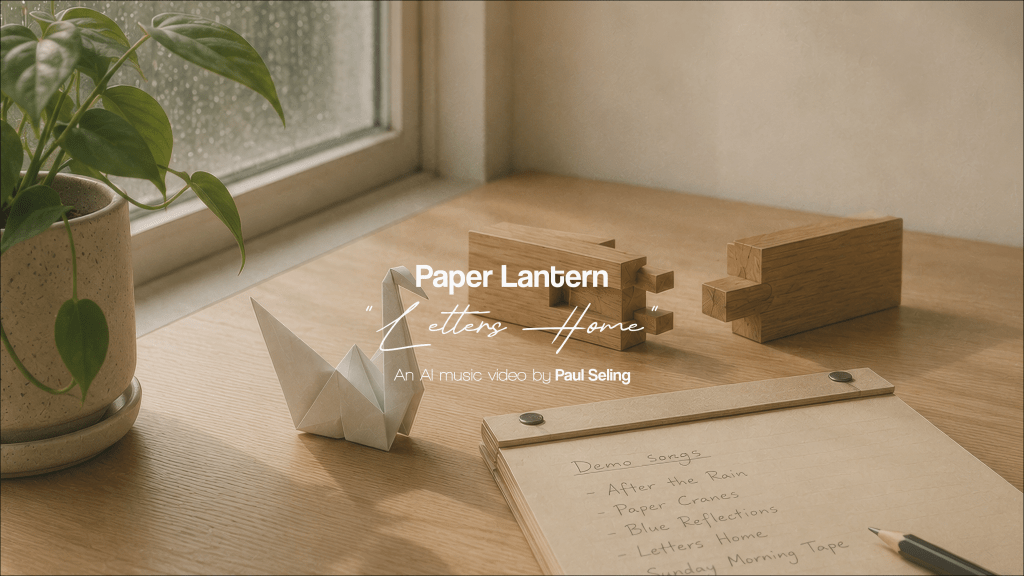
Lebăda și avionul concentrează discret întreaga tensiune a filmului. Sunt construite din aceeași coală de hârtie, însă una există pentru a fi contemplată, cealaltă pentru a fi aruncată în zbor. Una vorbește despre permanență și răbdare, cealaltă despre joc, mișcare și imprevizibil. Niciuna nu este superioară celeilalte; ele exprimă doar două feluri diferite de a înțelege apropierea dintre oameni.
Albumul After the Rain apare, astfel, ca o ironie subtilă. Obiectul pe care cei doi îl construiesc împreună nu reprezintă adevărata lor creație. Muzica devine doar sedimentul vizibil al unui proces mult mai important: timpul petrecut împreună, spațiul afectiv pe care îl locuiesc pentru o vreme și posibilitatea unei iubiri care nu ajunge niciodată să se exprime pe deplin. În această lectură, albumul nu documentează o relație; el păstrează amprenta unei posibilități.
Ultimele imagini mută sensul întregii povești fără a-l închide. Avionul de hârtie reapare într-un context nou, sugerând că simbolurile călătoresc mai departe decât oamenii. Spectatorul rămâne suspendat între interpretări: poate că tânăra este pregătită să înceapă o nouă relație, poate că recunoaște doar un ecou al trecutului sau poate că înțelege, pentru prima dată, că nici iubirea, nici apartenența nu pot fi garantate prin certitudini. Filmul nu oferă un verdict, pentru că miza lui nu este adevărul faptelor, ci felul în care psihicul transformă experiențele în narațiuni despre sine.
În cele din urmă, Letters Home vorbește despre fragilitatea ideii de „acasă”. Nu ca loc geografic, nici ca promisiune romantică, ci ca spațiu interior care apare, crește și dispare între doi oameni. Uneori, ceea ce rămâne după o întâlnire importantă nu este persoana, nici obiectele construite împreună, ci o altă versiune a propriei identități. La fel ca o coală de hârtie care, fără să-și schimbe materia, poate deveni o lebădă sau un avion, fiecare întâlnire autentică ne repliază într-o formă pe care nu am fi putut-o anticipa.
English version
Letters Home begins from an apparently simple premise—the encounter between two people from different worlds—in order to explore a far more fragile territory: the point at which love, memory and identity can no longer be separated. The film deliberately avoids definitive answers and refuses to determine whether the separation is the consequence of a real betrayal or merely the result of a perception shaped by previous experiences. Instead of offering certainty, it poses a different question: how much of what we see in another person truly belongs to them, and how much is a projection of ourselves?
In this sense, the protagonists function less as individuals and more as two complementary ways of inhabiting the world. One is oriented outward, toward creation, collaboration and movement; the other inward, toward memory, order and meaning. Their relationship is not built upon the opposition between truth and deception, but upon the impossibility of verifying whether the reality they share ever truly coincides with the reality each of them experiences internally. The gestures remain the same; only their meaning changes according to the gaze that interprets them.
The entire film is structured around the recurring motif of paper: the letter, architectural drawings, sheet music, the album cover, the origami swan and, finally, the paper airplane. All emerge from the same material, yet each acquires a different form through a simple sequence of folds. Identity is suggested here not as a fixed essence, but as a continuous process of transformation. A person does not become someone else; experience merely changes the way life folds them.
The swan and the airplane quietly concentrate the film’s central tension. They are both made from the same sheet of paper, yet one exists to be contemplated while the other exists to be thrown into flight. One speaks of permanence and patience; the other of play, movement and unpredictability. Neither is superior to the other—they simply embody two different ways of understanding closeness between people.
The After the Rain album therefore appears as a subtle irony. The object the two protagonists create together is not, in fact, their true creation. The music becomes only the visible sediment of something far more important: the time they shared, the emotional space they briefly inhabited together, and the possibility of a love that never fully found its expression. In this reading, the album does not document a relationship; it preserves the trace of a possibility.
The final images shift the meaning of the entire story without ever closing it. The paper airplane reappears in a different context, suggesting that symbols travel farther than people do. The viewer is left suspended between interpretations: perhaps the young woman is ready to begin a new relationship; perhaps she simply recognizes an echo of the past; or perhaps, for the first time, she understands that neither love nor belonging can ever be secured through certainty. The film offers no verdict, because its true subject is not the factual truth of events, but the way the human psyche transforms experience into narratives about itself.
Ultimately, Letters Home reflects on the fragility of the idea of “home.” Not as a geographical place, nor as the promise of romantic love, but as an inner space that emerges, grows and eventually disappears between two people. Sometimes what remains after a meaningful encounter is neither the person nor the objects created together, but a different version of oneself. Like a sheet of paper that, without changing its substance, can become either a swan or an airplane, every authentic encounter folds us into a shape we could never have anticipated.


Leave a Reply