Cadrul: un oraș care n-a găsit încă un limbaj pentru ce a devenit
Baia Mare de după 2000 e un oraș care și-a pierdut identitatea economică fără să-și fi găsit alta. Mina, care organizase generații întregi de vieți — program, ierarhie, mândrie de breaslă, o anumită austeritate colectivă — a dispărut, sau a devenit o umbră administrativă, în timp ce discursul public al tranziției promitea “afaceri locale”, antreprenoriat, o clasă de mici comercianți și meseriași care să umple golul. Ce a rămas efectiv, pentru mulți, a fost altceva: gașca de bar, plaja, balconul, baia colectivă de duminică — forme sociale vechi, dinainte de ’89, reîmbrăcate acum într-un decor pretins nou, dar fără conținutul economic promis. Titlul seriei, Local Business, e o glosă ironică exact pe acest gol: nu există nicio afacere reală în ce arată desenele, doar o comunitate care se regrupează în ritualuri vechi de supraviețuire socială, sub o etichetă nouă.
Peste acest gol economic stă o memorie vizuală mai veche — cea a almanahurilor umoristice comuniste și a ilustrațiilor din revistele pentru copii dinainte de revoluție. Paleta stinsă, desaturată, a seriei nu e o alegere stilistică deliberată, ci o amprentă formată în copilărie, un fel de a vedea culoarea fixat înainte de a exista control conștient asupra ei. Ce e nou, însă, e conținutul pe care această formă veche îl ține acum: beție, indiferență, promiscuitate ambiguă, o cameraderie fără miez — raporturi care aparțin unei lumi post-comuniste încă nefamiliarizate cu propriile ei reguli noi. Forma veche funcționează ca un container pentru o realitate pe care societatea n-o digerase încă.
Profilul psihologic al comunității: gașca și apatia ca reflex de supraviețuire
Ce developează seria, dincolo de umorul de suprafață, e un profil colectiv destul de precis al unei societăți mici, post-industriale, care nu mai are un scop economic comun și care s-a retras în forme sociale reziduale.
Prima observație e că sociabilitatea aici e aproape exclusiv de gașcă, niciodată individuală în sens pozitiv. Grupurile — la bar, pe plajă, în jacuzzi, pictând graffiti — funcționează ca un liant, dar unul superficial: beția, petrecerea, ritualul comun par să țină oamenii laolaltă mai degrabă din lipsa altei structuri (loc de muncă stabil, proiect comun, perspectivă de viitor) decât dintr-o legătură reală, aleasă. E o sociabilitate de inerție, nu de alegere — oamenii se adună pentru că nu au altceva de făcut, nu pentru că au ceva anume de construit împreună.
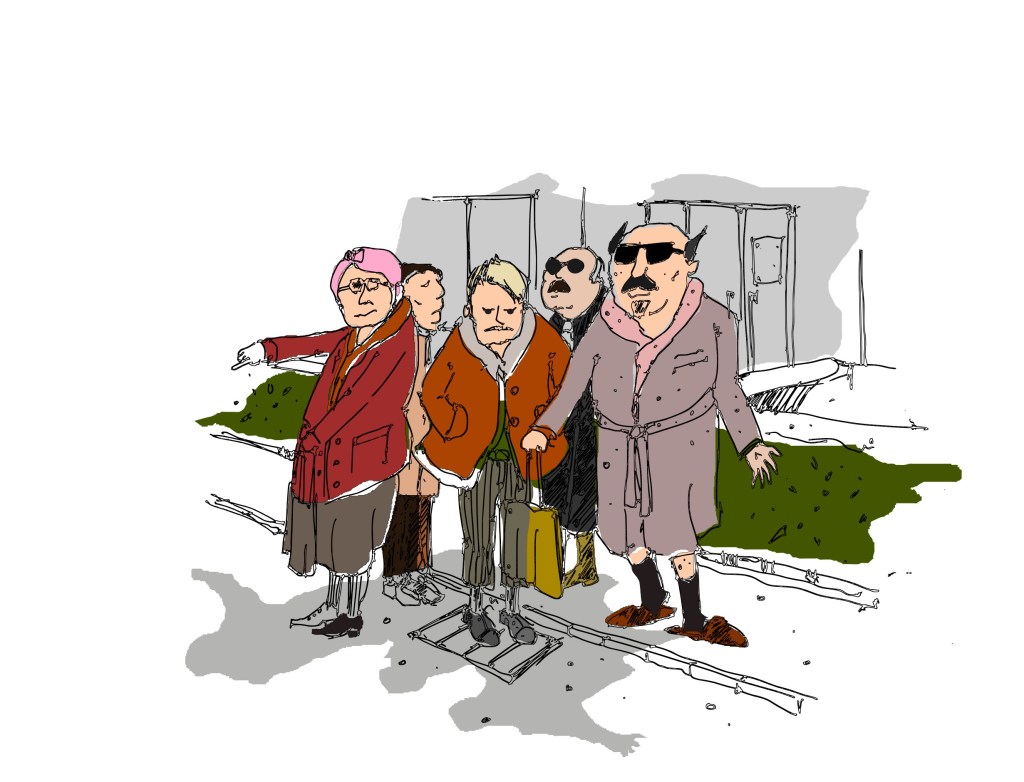
A doua observație, mai dură, e apatia colectivă în fața suferinței individuale. Scena cu un bărbat căzut pe trotuar, neasistat de nimeni din jurul lui — ceilalți continuând pur și simplu să stea, indiferenți — e cea mai directă imagine a acestui mecanism: comunitatea nu e ostilă activ, dar nici solidară activ. E doar prezentă, martoră pasivă, ocupată cu propriile ei ritualuri mărunte. Aceeași apatie apare, într-un registru mai blând, în șirul de bărbați care merg aproape identic, cu gesturi și poziții corporale suprapuse, ca o procesiune anonimă fără destinație clară — un fel de mers colectiv fără scop, aproape mecanic.
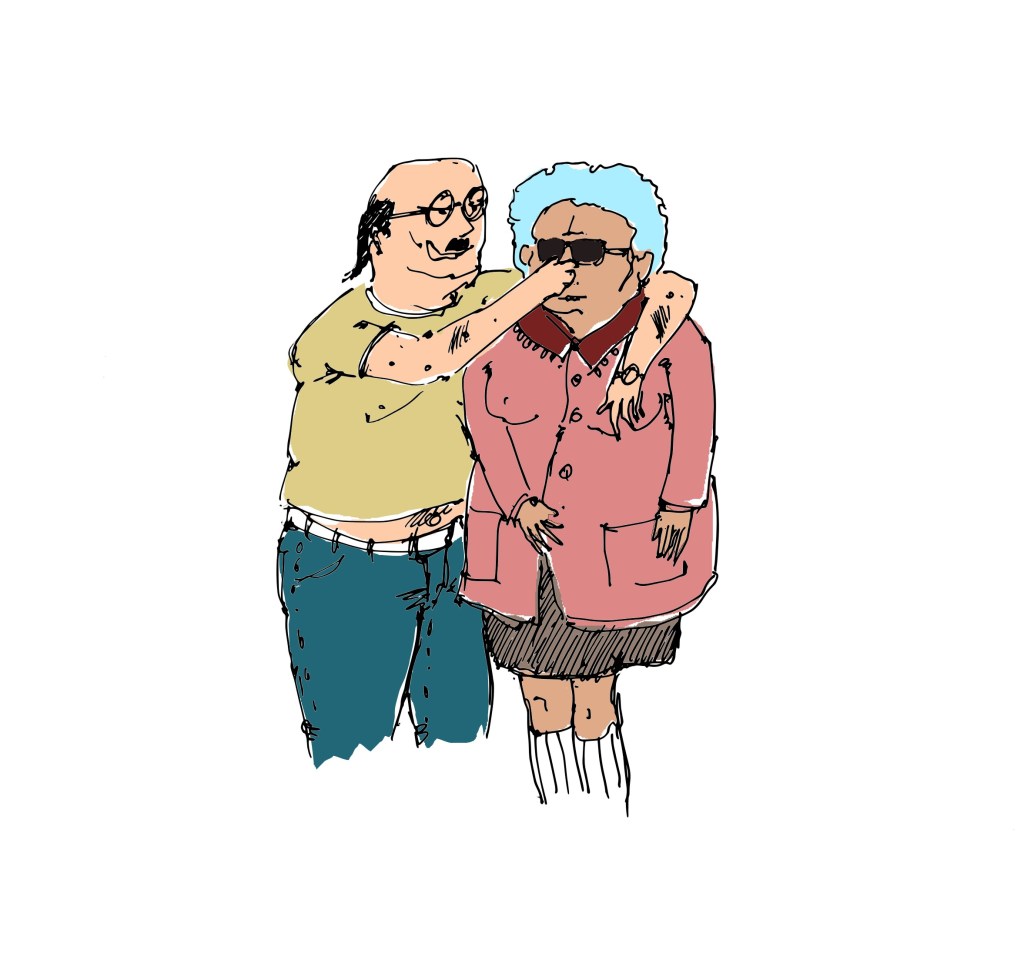
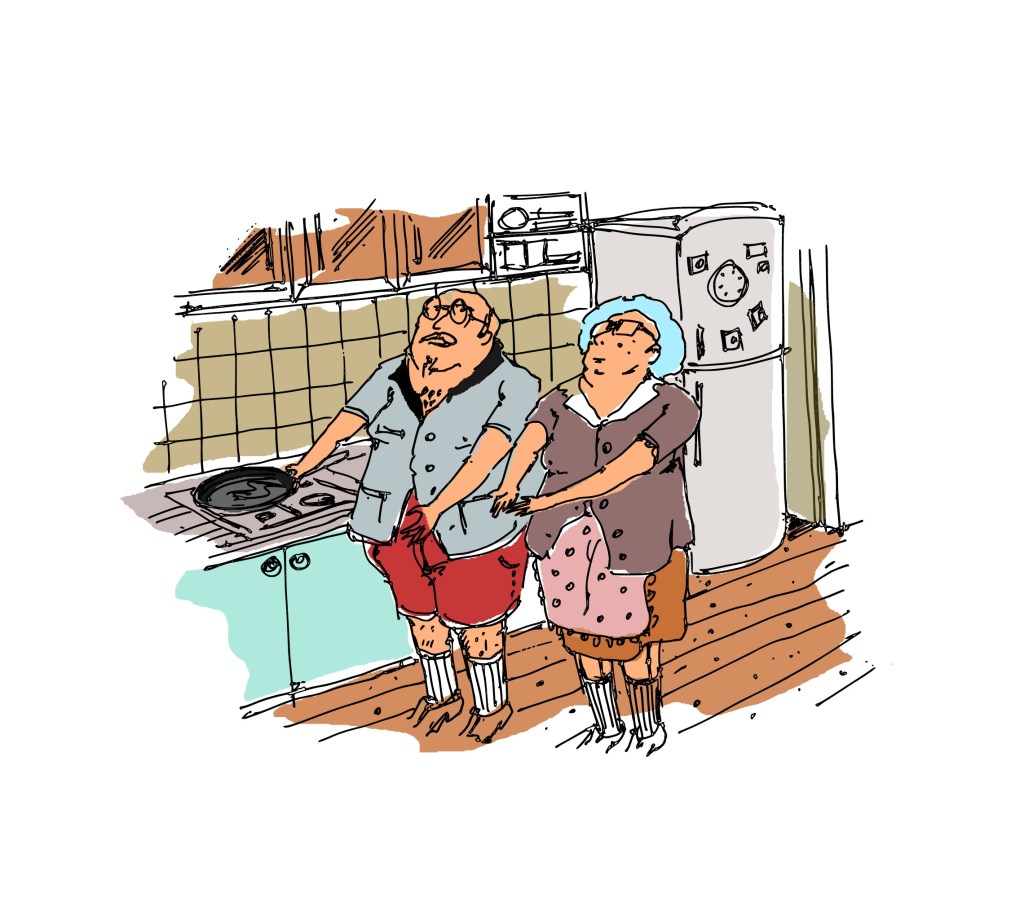
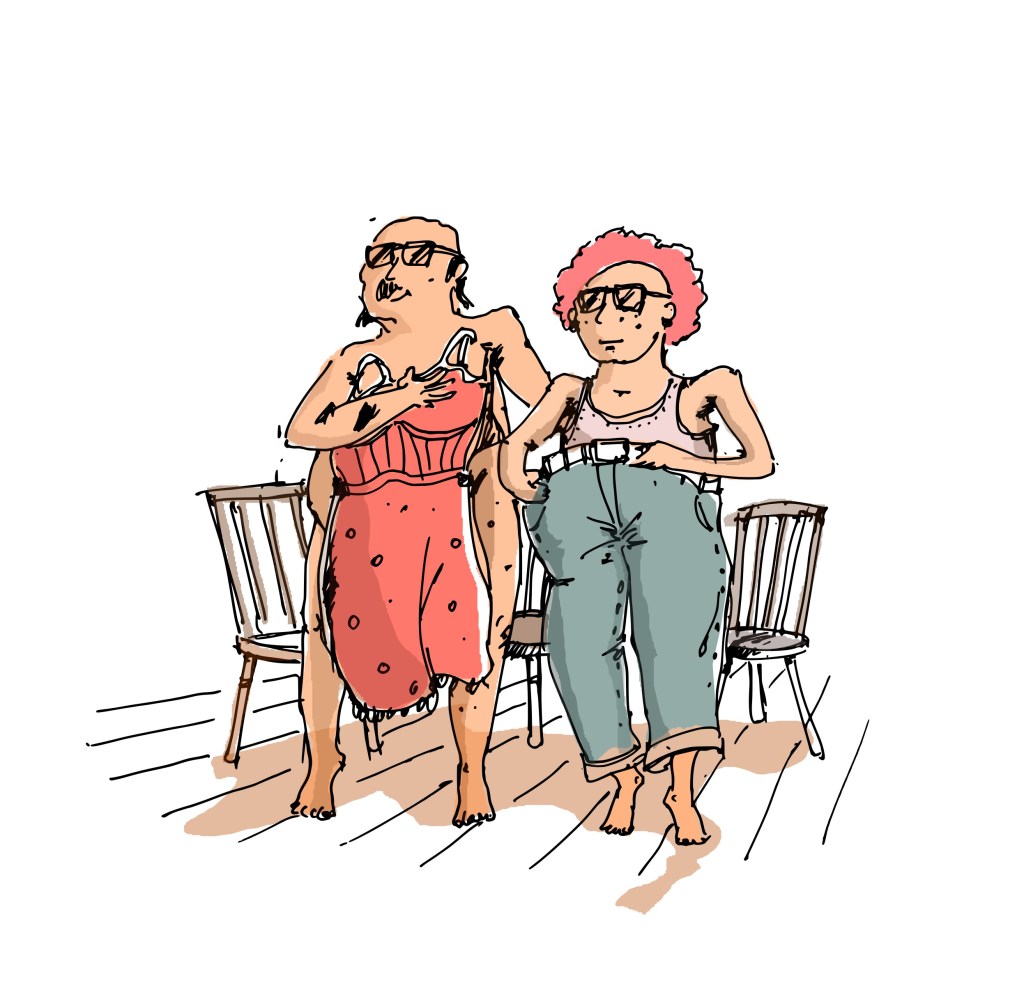
A treia observație privește bătrânețea, tratată în serie cu o combinație rară de comedie și blândețe. Cuplurile în vârstă care se dezbracă sau se îmbracă unul lângă altul, gestul de a-și ciupi reciproc nasul, sprijinul fizic mutual — toate developează bătrânețea nu ca declin demn sau ca grotesc, ci ca un soi de joacă tandră, aproape infantilă, care refuză atât rigiditatea, cât și disprețul. E o comunitate care, chiar și epuizată de istorie, mai păstrează un reflex de blândețe unul față de celălalt, la firul ierbii, chiar dacă nu-l poate mobiliza la scară mai mare (vezi bărbatul căzut, neajutat).
Istoria ca fundal tăcut, nu ca temă activă
O parte din desene lasă să se vadă o memorie istorică rămasă atârnată, mai degrabă decât discutată. Un portret al lui Hitler apare doar ca tablou de perete, privit indirect de personajele din prim-plan, ocupate cu viața lor mică — nu personaj activ, ci amprentă istorică absorbită tacit în decor, ca un fapt divers al locuinței. Această alegere developează o observație despre memoria colectivă din regiune: istoria grea a secolului XX nu e procesată activ, discutată, confruntată — e doar prezentă, atârnată, parte din fundal, în timp ce viața cotidiană își continuă cursul mărunt, indiferentă la ea.
Corpul ca sit al observației sociale
O bună parte din serie developează observația socială prin corp — corpul dezbrăcat, corpul bătrân, corpul rănit sau imobilizat. Clasa de desen după model, cu un bărbat gol întins pe o masă și un cerc de privitori-artiști în jur, e o imagine despre expunerea publică fără intimitate — corpul ca obiect de studiu colectiv, lipsit de orice discreție. Scenele de familie cu bandaje, ghips, pete pe piele developează corpul marcat de mica dramă cotidiană, tratată fără pathos, ca un fapt banal al vieții. Baia colectivă a bătrânilor, jocul cu mingea în apă, developează, în schimb, o formă de bucurie fizică simplă, aproape naivă, care persistă în ciuda vârstei și a contextului sărăcăcios.
Mecanismul de travesti animal ca instrument de distanțare
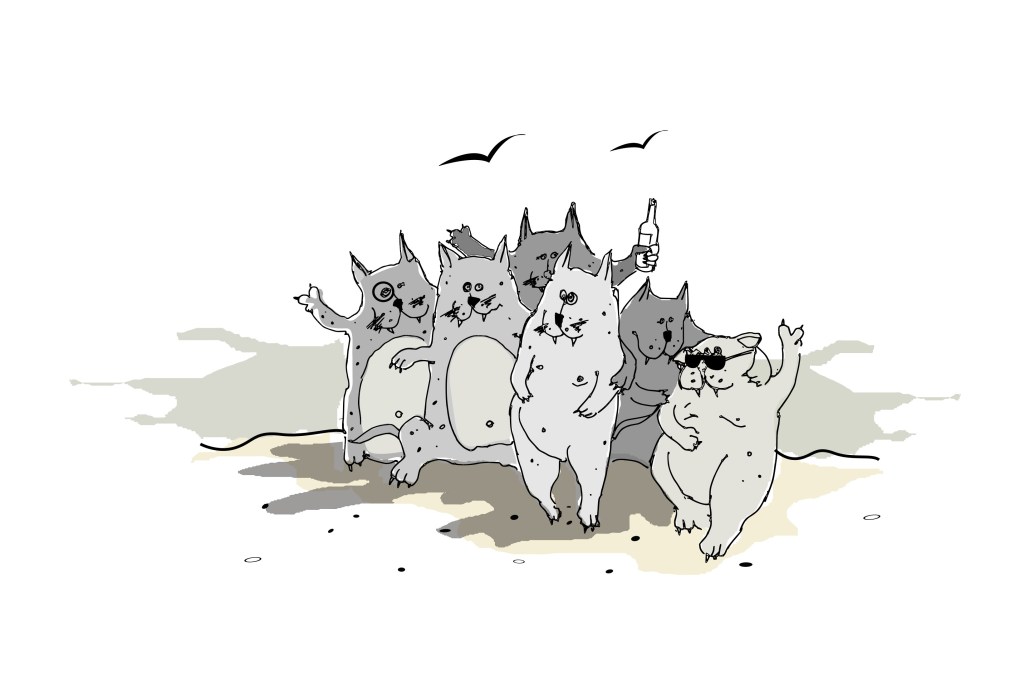
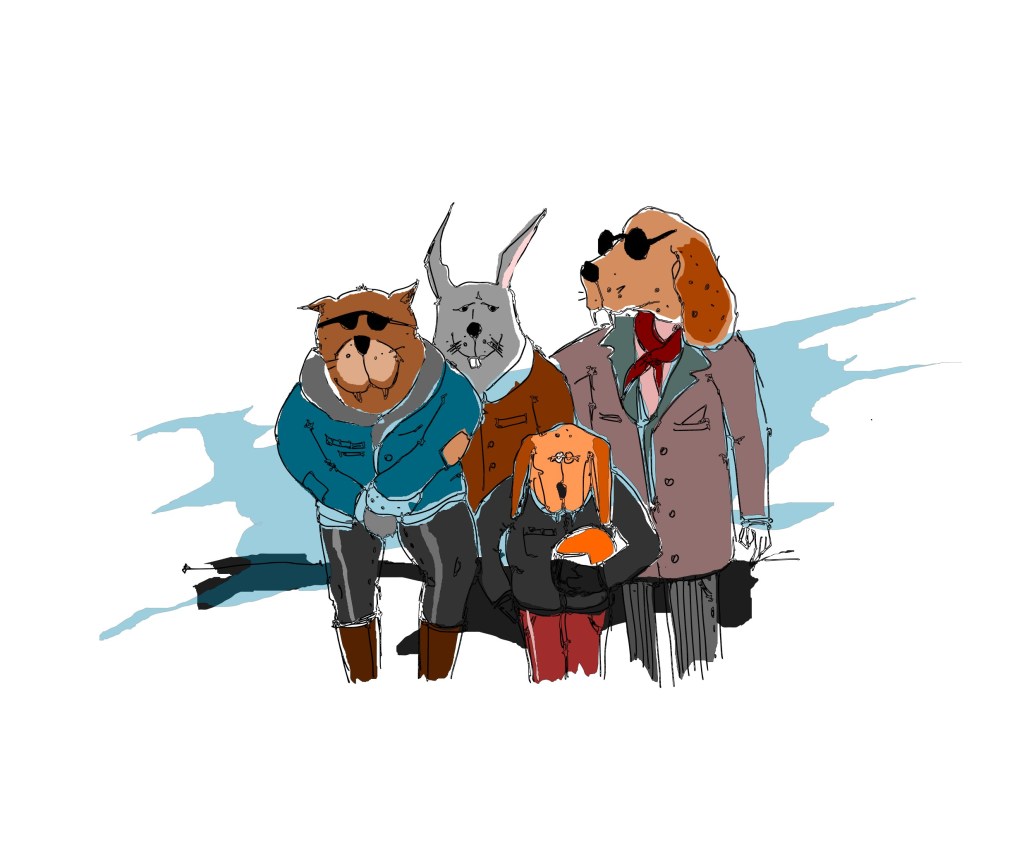
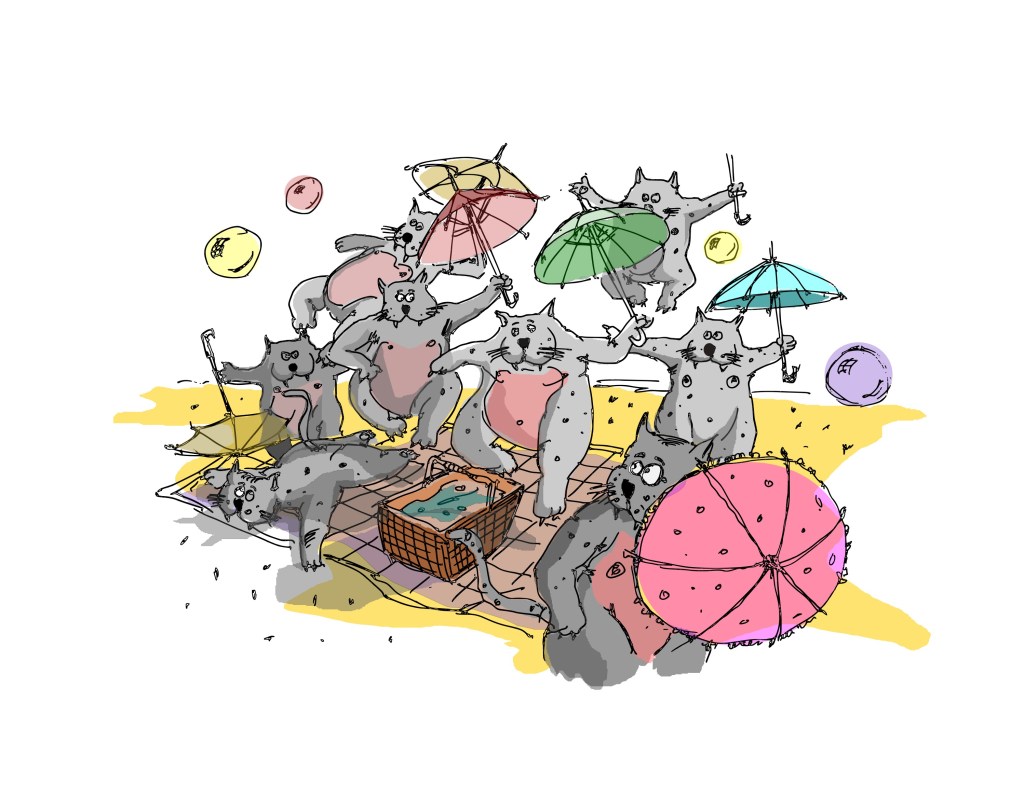
Tehnic, seria alternează sistematic între două regimuri: scenele cu oameni reali, fără mediere, și scenele cu animale antropomorfizate (pisici, câini, un iepure recurent), care poartă haine, beau, se ceartă, se distrează exact ca oamenii. Travestiul animal funcționează aici ca un instrument clasic de caricatură — permite developarea unei observații sociale pe care figura umană directă n-ar suporta-o fără să devină acuzatoare sau tristă. O pisică beată la bar, înconjurată de alte pisici identice, e comică, ușor de privit; un om beat în aceeași poziție ar fi doar trist. Distanța dată de blana și mustățile desenate ține observația la un nivel suportabil, jucăuș, fără să-i reducă din exactitate.
Această alternanță — uneori aceeași scenă de gașcă apare atât cu oameni, cât și cu animale, în desene diferite — sugerează un test constant al limitei: cât din observație poate suporta figura umană directă, și de la ce punct e nevoie de travesti ca scena să rămână privibilă, chiar amuzantă, fără să devină o acuzație frontală la adresa celor din jur.
O singură figură ruptă de tipar
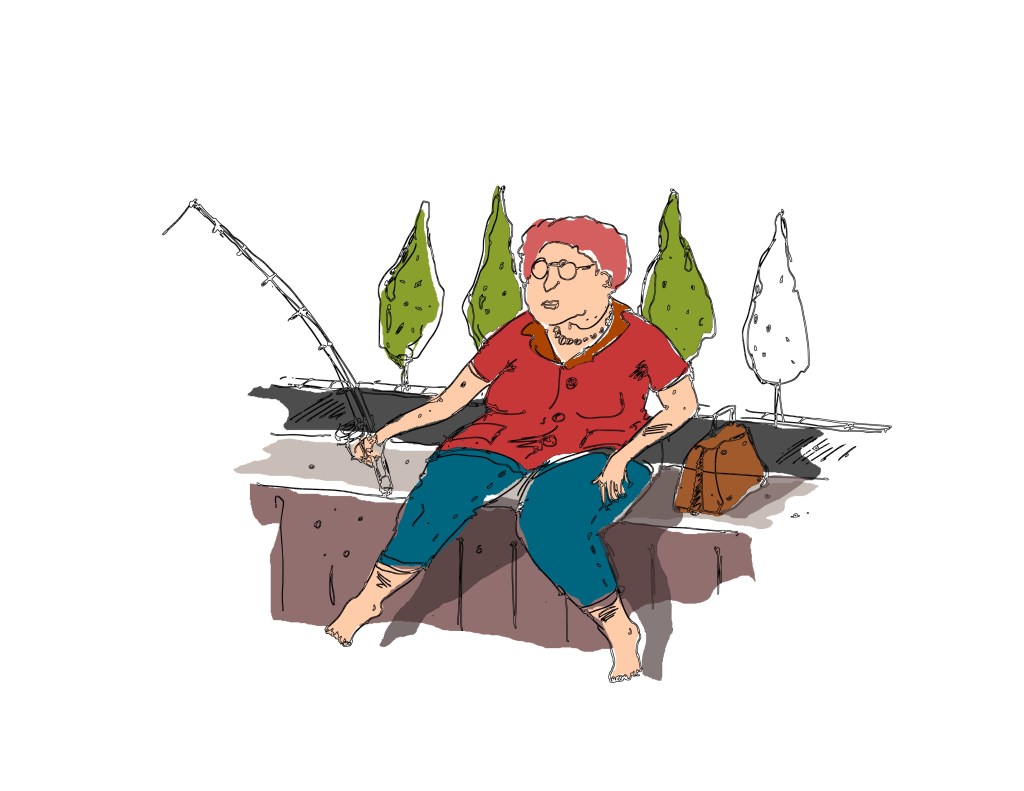
Printre atâtea scene de grup, o singură imagine developează izolarea completă: o femeie în vârstă, singură, cu o undiță, lângă apă, printre chiparoși aproape funerari, simetrici. Spre deosebire de restul seriei, această scenă n-a avut nevoie de travesti animal — observația nu era una care necesita distanță comică, ci una directă, aproape documentară, despre o viață oprită în loc, trăită prin repetarea unui gest (pescuitul) care nu mai duce nicăieri. E singurul moment din serie în care comunitatea dispare complet din cadru, și rămâne doar un individ, singur cu inerția lui.
Local Business rămâne, în fond, un instantaneu — un fel de a nota grafic, cu umor și cu o anumită tandrețe pentru defectele privite, o stare a unei comunități mici, la câțiva ani distanță de comunism și fără o direcție economică nouă clar conturată, în care oamenii încă mai caută forme vechi de a fi împreună, într-o lume care le-a schimbat regulile fără să le fi explicat vreodată noile reguli.











English version
The frame: a city without a language for what it had become
Baia Mare after 2000 is a city that lost its economic identity without finding a new one. The mine, which had organized entire generations of lives — schedule, hierarchy, guild pride, a certain collective austerity — disappeared, or became an administrative shadow, while the public discourse of the transition promised “local business,” entrepreneurship, a class of small merchants and craftsmen who would fill the gap. What actually remained, for many, was something else: the bar crowd, the beach, the balcony, the collective Sunday bath — old social forms, pre-1989, now dressed in a supposedly new setting, but without the promised economic substance. The title of the series, Local Business, is an ironic gloss on exactly this gap: there is no real business in what the drawings show, only a community regrouping itself around old rituals of social survival, under a new label.
Over this economic void sits an older visual memory — that of communist-era humor almanacs and children’s magazine illustrations from before the revolution. The series’ muted, desaturated palette is not a deliberate stylistic choice but an imprint formed in childhood, a way of seeing color fixed before any conscious control over it existed. What is new, however, is the content this old form now holds: drinking, indifference, ambiguous promiscuity, a camaraderie without real substance — relations belonging to a post-communist world still unfamiliar with its own new rules. The old form functions as a container for a reality society had not yet digested.
The psychological profile of the community: the pack and apathy as a survival reflex
What the series develops, beneath its surface humor, is a fairly precise collective profile of a small, post-industrial society that no longer has a shared economic purpose and has retreated into residual social forms.
The first observation is that sociability here is almost exclusively of the pack, never individual in a positive sense. Groups — at the bar, on the beach, in the jacuzzi, spray-painting graffiti — function as glue, but a superficial one: drinking, partying, shared ritual seem to hold people together more out of the absence of any other structure (stable work, a shared project, a sense of future) than out of a real, chosen bond. It is a sociability of inertia, not of choice — people gather because they have nothing else to do, not because they have something specific to build together.
The second, harsher observation is collective apathy in the face of individual suffering. The scene of a man fallen on the sidewalk, unassisted by anyone around him — the others simply standing by, indifferent — is the most direct image of this mechanism: the community is not actively hostile, but neither is it actively caring. It is merely present, a passive witness, occupied with its own small rituals. The same apathy appears, in a gentler register, in the row of men walking almost identically, with overlapping gestures and postures, like an anonymous procession without a clear destination — a kind of purposeless, almost mechanical collective march.
The third observation concerns old age, treated in the series with a rare mix of comedy and tenderness. The elderly couples undressing or dressing beside one another, the gesture of pinching each other’s nose, mutual physical support — all of it develops old age not as dignified decline or grotesque, but as a kind of tender, almost childlike play that refuses both rigidity and contempt. It is a community that, even worn down by history, still holds onto a reflex of gentleness toward one another at the small scale, even if it cannot mobilize that same gentleness at a larger one (see the fallen man, unaided).
History as a silent backdrop, not an active theme
Some of the drawings let a historical memory show through as something left hanging rather than actively discussed. A portrait of Hitler appears only as a wall painting, glanced at indirectly by the foreground characters, busy with their own small lives — not an active character, but a historical imprint tacitly absorbed into the décor, a mere household detail. This choice develops an observation about collective memory in the region: the heavy history of the twentieth century is not actively processed, discussed, confronted — it is simply present, hanging, part of the background, while everyday life continues its small course, indifferent to it.
The body as the site of social observation
A good part of the series develops its social observation through the body — the naked body, the aging body, the injured or immobilized body. The life-drawing class, with a naked man stretched on a table and a circle of artist-observers around him, is an image about public exposure without intimacy — the body as an object of collective study, stripped of any discretion. The family scenes with bandages, casts, marks on the skin develop the body marked by small everyday drama, treated without pathos, as a banal fact of life. The elderly’s collective bath, the ball game in the water, develops instead a form of simple, almost naive physical joy that persists despite age and the modest setting.
The animal-disguise mechanism as a tool of distance
Technically, the series alternates systematically between two registers: scenes with real people, unmediated, and scenes with anthropomorphized animals (cats, dogs, a recurring rabbit) who wear clothes, drink, argue, and have fun exactly like people. The animal disguise functions here as a classic caricature device — it allows a social observation to be developed that the direct human figure could not bear without becoming accusatory or sad. A drunk cat at a bar, surrounded by identical cats, is comic, easy to look at; a man in the same posture would simply be sad. The distance granted by the drawn fur and whiskers keeps the observation at a bearable, playful level, without losing any of its precision.
This alternation — sometimes the same pack scene appears both with humans and with animals, in different drawings — suggests a constant testing of the boundary: how much observation the direct human figure can bear, and at what point a disguise becomes necessary for the scene to remain viewable, even funny, without turning into a frontal accusation against the people around.
A single figure breaking the pattern
Among so many group scenes, a single image develops complete isolation: an elderly woman, alone, with a fishing rod, by the water, among nearly funereal, symmetrical cypress trees. Unlike the rest of the series, this scene needed no animal disguise — the observation was not one requiring comic distance, but a direct, almost documentary one, about a life stalled in place, lived through the repetition of a gesture (fishing) that no longer leads anywhere. It is the only moment in the series where the community disappears entirely from the frame, leaving only an individual, alone with her inertia.
Local Business remains, in the end, a snapshot — a way of graphically noting, with humor and a certain tenderness toward the flaws observed, the state of a small community, a few years removed from communism and without a clearly defined new economic direction, in which people still search for old ways of being together, in a world that had changed their rules without ever explaining the new ones to them.


Leave a Reply